Technical Guides · 2025-04-11
PID vs ON/OFF Control: Which Temperature Control Method is Right for You?
This article compares PID and ON/OFF temperature control methods for industrial automation. Learn the pros, cons, and application scenarios for selecting the right controller.
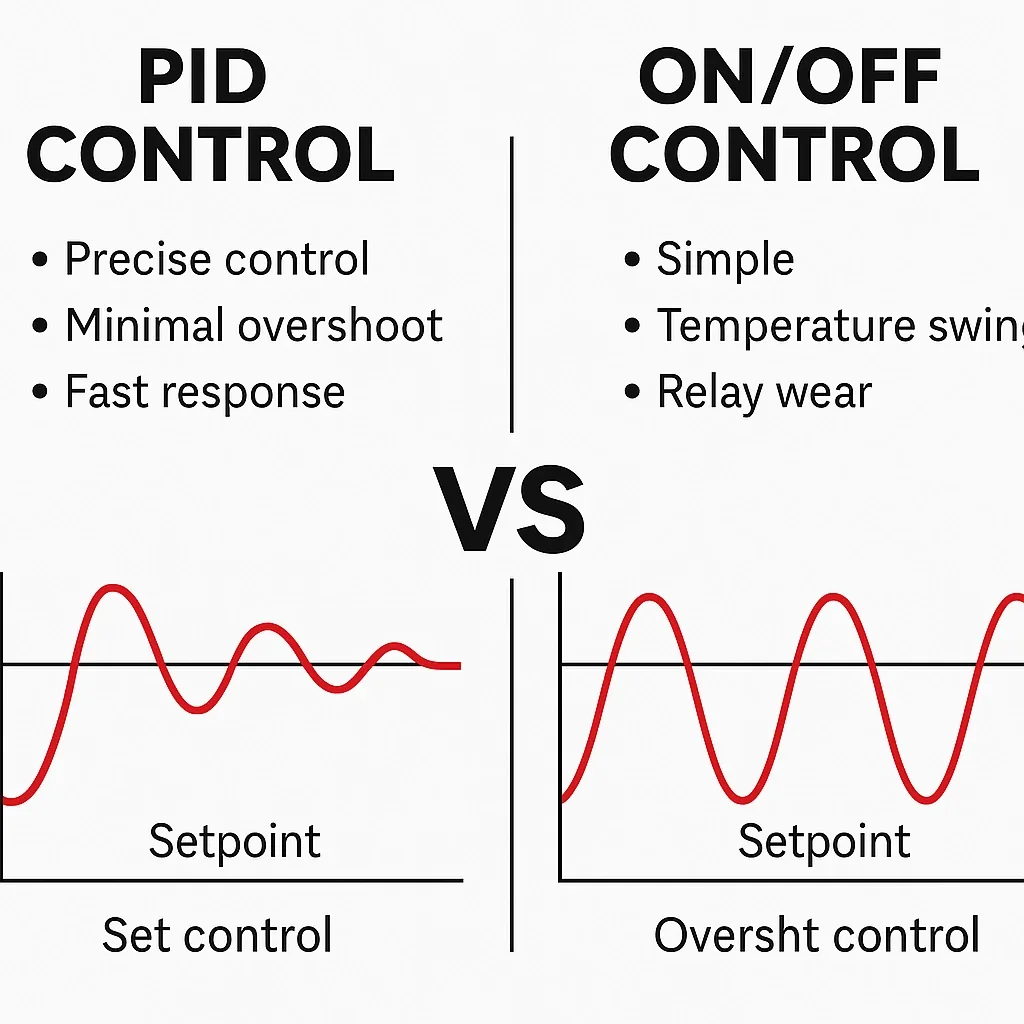
When it comes to temperature control in industrial automation, two primary methods dominate: PID (Proportional–Integral–Derivative) and ON/OFF control. Both have specific advantages, and understanding their principles and applications will help you select the right controller for your system.
What is ON/OFF Control?
ON/OFF control is the most basic form of automation logic. When the process temperature drops below the setpoint, the output turns ON. When the temperature exceeds the setpoint, the output turns OFF.
- Advantages:
- Simple and low-cost
- Easy to implement
- Reliable for non-critical systems
- Drawbacks:
- Temperature fluctuates around the setpoint (hysteresis)
- Not suitable for systems requiring precise stability
- Can cause relay wear due to frequent switching
✅ Ideal for: Ovens, dryers, incubators, and basic HVAC where slight overshoot or undershoot is acceptable.
What is PID Control?
PID control uses a mathematical algorithm to adjust the output continuously based on:
- Proportional (current error)
- Integral (past error over time)
- Derivative (rate of error change)
This allows precise control with minimal overshoot, stable operation, and fast response to temperature changes.
- Advantages:
- Smooth, precise temperature control
- Minimal oscillation or overshoot
- Good for thermal-sensitive processes
- Drawbacks:
- Requires tuning (auto-tuning helps)
- Slightly higher cost
- More complex setup
✅ Ideal for: Plastic extrusion, blow molding, laboratory heating, and applications needing tight control.
Real-World Comparison
| Feature | ON/OFF Control | PID Control |
|---|---|---|
| Control Method | Binary (0 or 1) | Continuous adjustment |
| Accuracy | ±3–5°C | ±0.1–1°C |
| Setup | Simple | Requires parameter tuning |
| Cost | Lower | Slightly higher |
| Application Example | Oven thermostat | Plastic injection machine |
| Wear on Relays | Higher (frequent cycles) | Lower with SSR output |
Controller Examples from Strong Electric
- ✅ TEL96-9001 / TCR Series – current digital ON/OFF controllers for ovens and heating equipment
- ✅ REX-C Series – Economical PID controllers with auto-tuning
- ✅ TC4/CH Series – Versatile dual-display PID/ONOFF controllers