
Technical Guides · 2025-04-11
Solid State Relay (SSR) vs. Mechanical Relay: What’s the Difference and When to Use Each
This article compares SSR and mechanical relays by switching speed, lifespan, load compatibility, and usage scenarios—helping you decide which is best for your power control application.
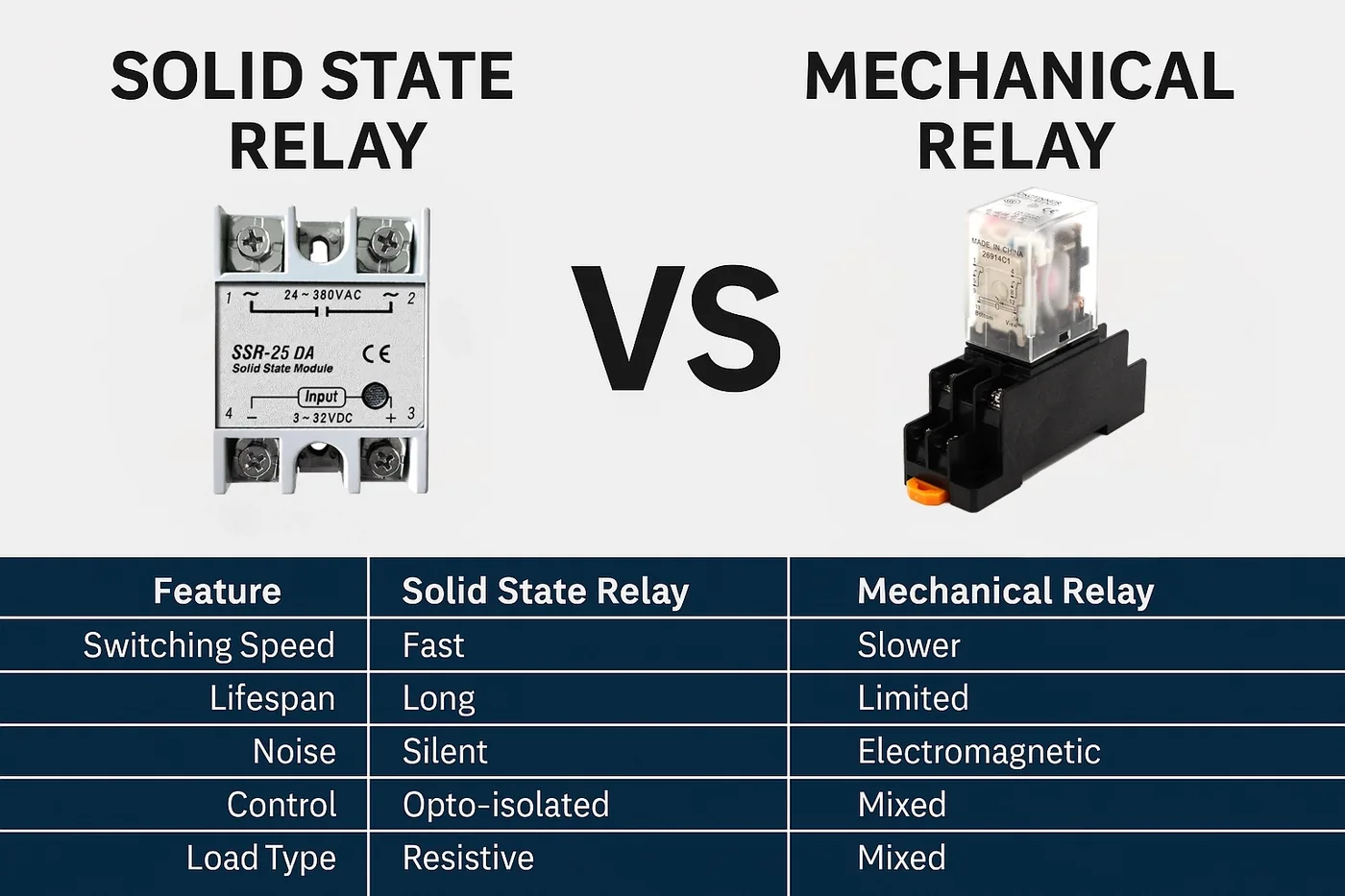
When choosing a switching device for your automation or power control project, you’ll likely consider two main options: Solid State Relays (SSR) and Mechanical Relays (Electromagnetic Relays, EMR). While both serve the purpose of switching electrical loads, they differ significantly in structure, performance, and best-use scenarios.
What is a Solid State Relay (SSR)?
An SSR uses semiconductor components (such as SCR, TRIAC, or MOSFETs) to perform switching without any moving parts. It is triggered by a small control voltage and uses optical isolation to control high voltage AC or DC loads.
What is a Mechanical Relay?
A mechanical relay relies on a physical electromagnetic coil that moves contacts to open or close a circuit. It’s widely used in general-purpose industrial controls where switching frequency is low and audible feedback is acceptable.
Key Differences Between SSR and Mechanical Relay
| Feature | Solid State Relay (SSR) | Mechanical Relay (EMR) |
|---|---|---|
| Switching Method | Semiconductor (no moving parts) | Electromechanical contacts |
| Switching Speed | Very fast (microseconds) | Slower (milliseconds) |
| Lifespan | Long (no wear from arcing) | Limited (contact wear) |
| Noise | Completely silent | Audible clicking sound |
| Control Isolation | Opto-isolated | Electromagnetic |
| Load Type | Ideal for resistive, inductive (with care) | Good for mixed load types |
| Heat Generation | Can require heatsinks for high loads | Minimal in low-frequency switching |
| Cost | Higher upfront cost | Lower cost, but more maintenance |
When Should You Use Each?
✅ Use an SSR when:
- You need high-speed switching
- Silent operation is required
- You control heating elements, lamps, or resistive loads
- Long operational life with no mechanical wear is critical
✅ Use a Mechanical Relay when:
- Cost is a primary concern
- Switching frequency is low
- You need to switch mixed or high inrush current loads
- Audible feedback is acceptable or preferred