
Technical Guides · 2026-08-24
How to Choose a Threaded Temperature Sensor: K, E Thermocouple or Pt100 RTD
A selection and installation guide for M6 / M8 threaded temperature sensor probes: how thermocouples and RTDs differ, which element to specify, how thread size and mounting affect the reading, lead length and shielding, terminal polarity and the controller settings to check at commissioning.
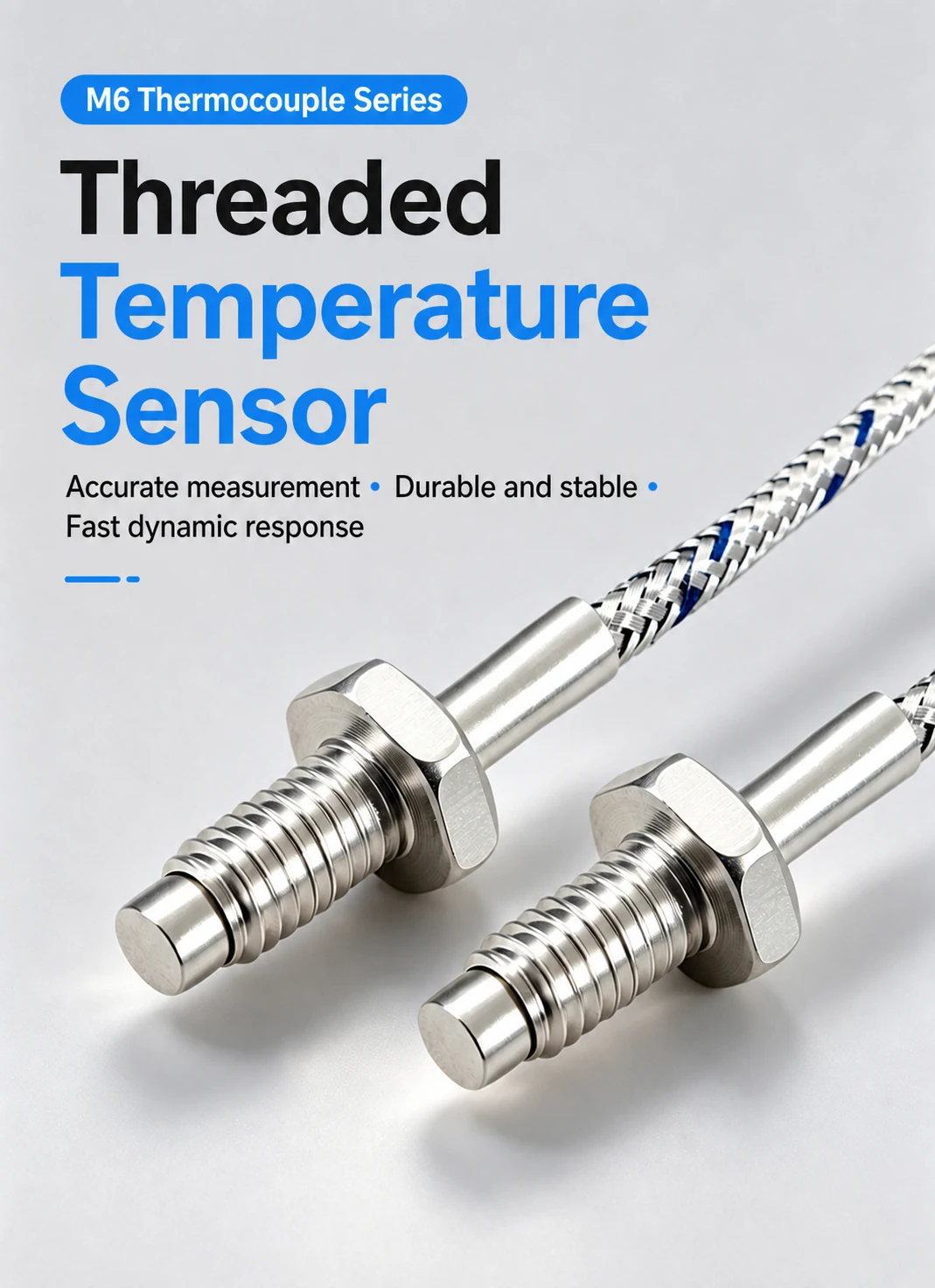
Threaded temperature sensors are the workhorse probe of industrial heating: a metal ring or bolt with a machined thread, screwed onto a heater band, platen, mould or machine body so the sensing element sits in firm contact with the surface being controlled. This guide covers how to specify one correctly — element type, thread, lead and terminals — and the controller settings to check before the first heat-up. The matching hardware is our M6 / M8 threaded temperature sensor probe.
1. Thermocouple or RTD: how the two elements differ
A thermocouple is two dissimilar metal wires joined at the tip. The junction generates a voltage of a few tens of microvolts per degree, which the controller reads against its own cold-junction reference. It is simple, rugged and works to very high temperatures, but the signal is small and vulnerable to electrical noise.
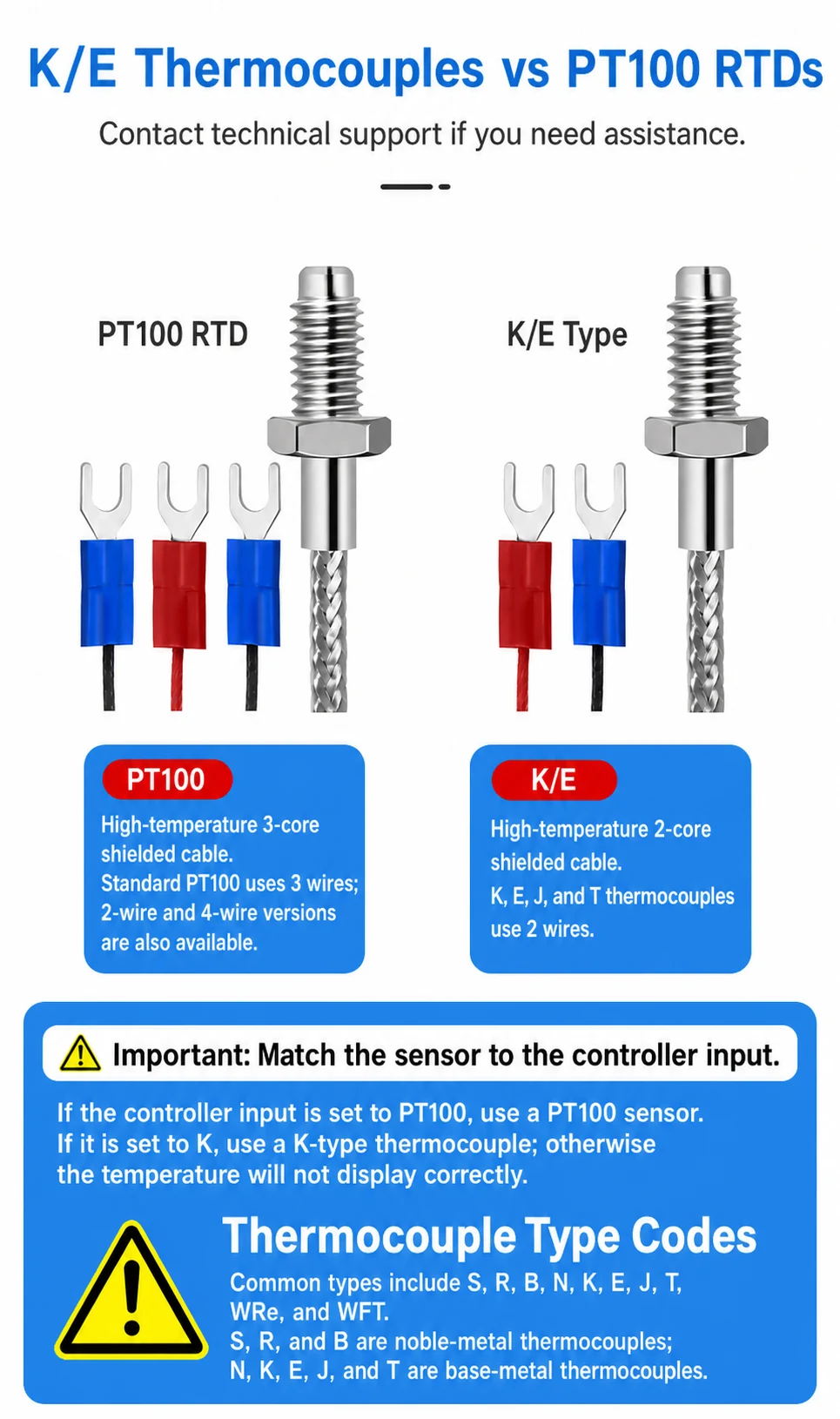
An RTD such as Pt100 is a platinum element whose resistance rises predictably with temperature — 100 Ω at 0 °C. The controller measures resistance, not voltage. Three leads are used so the controller can subtract the resistance of the cable itself. RTDs are more accurate and more stable than thermocouples, but the practical range stops well below what a K type will survive.
2. Choosing between K type, E type and Pt100
| Element | Range | Choose it when |
| K type thermocouple | 0–800 °C | General heating: extruder barrels, heater bands, ovens, moulds. Widest range, lowest cost, most widely supported controller input. |
| E type thermocouple | 0–600 °C | You want more millivolts per degree than K over a moderate range, for better resolution on a long cable run. |
| Pt100 RTD (3-wire) | -50–400 °C | Accuracy and long-term stability below 400 °C: drying ovens, laminating, low-temperature process control. |
The elements are not interchangeable in the field. If the controller input parameter says K and a Pt100 is fitted, the display will look plausible at room temperature and be badly wrong hot. Set the input type to match the probe, and label the probe.
3. Thread size and mounting
The M6 probe is offered in two pitches: M6 x 1.0 (fine pitch, the common option in China) and M6 x 1.25 (coarse pitch, the common export option). M8 x 1.25 is also stocked, and other threads, including inch sizes, are made to order. Match the pitch as well as the diameter — a wrong-pitch probe starts to turn and then binds, damaging the tapped hole. If you are unsure, check the thread against a pitch gauge, or send the tapped hole size or a sample with the enquiry.
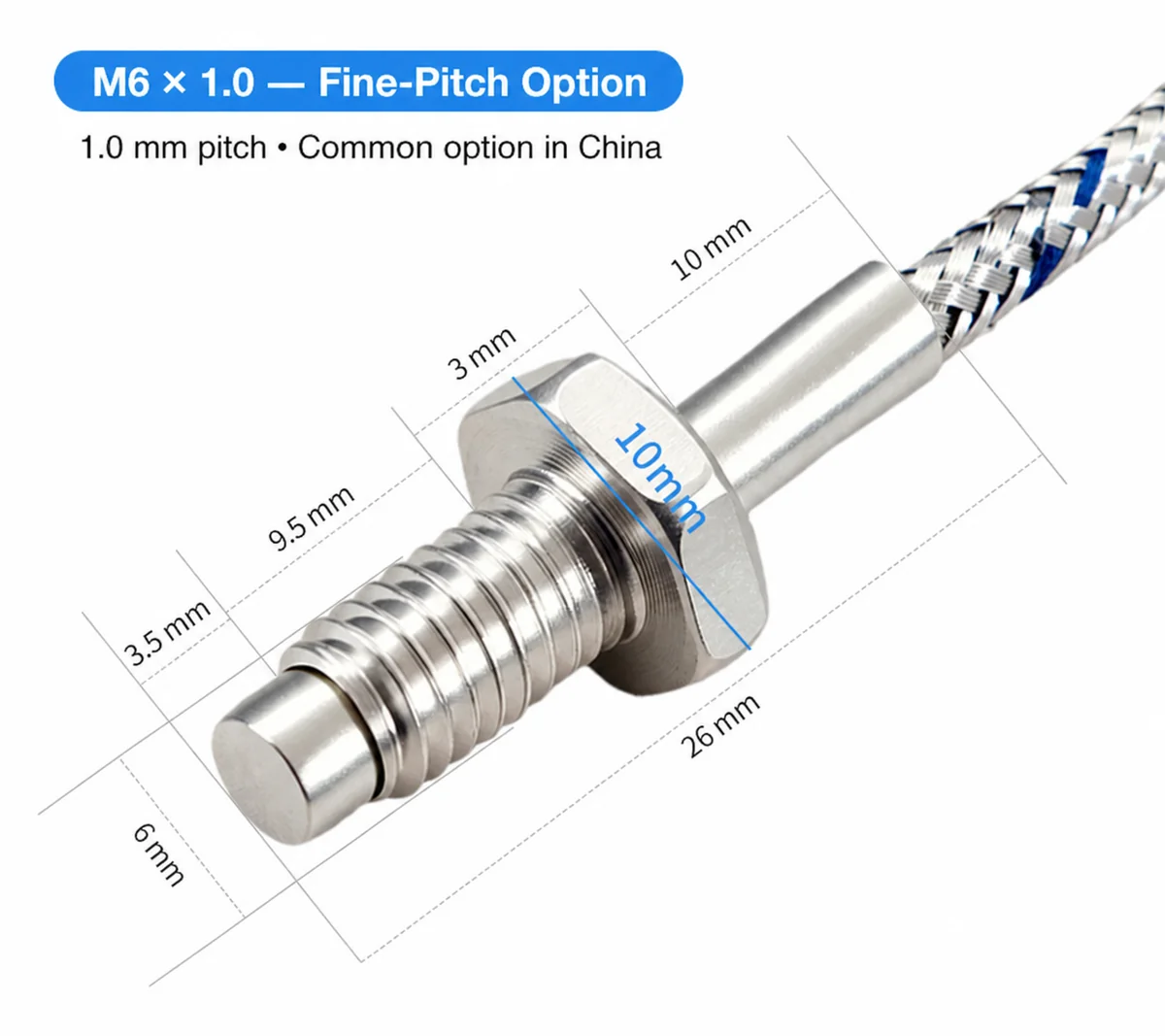
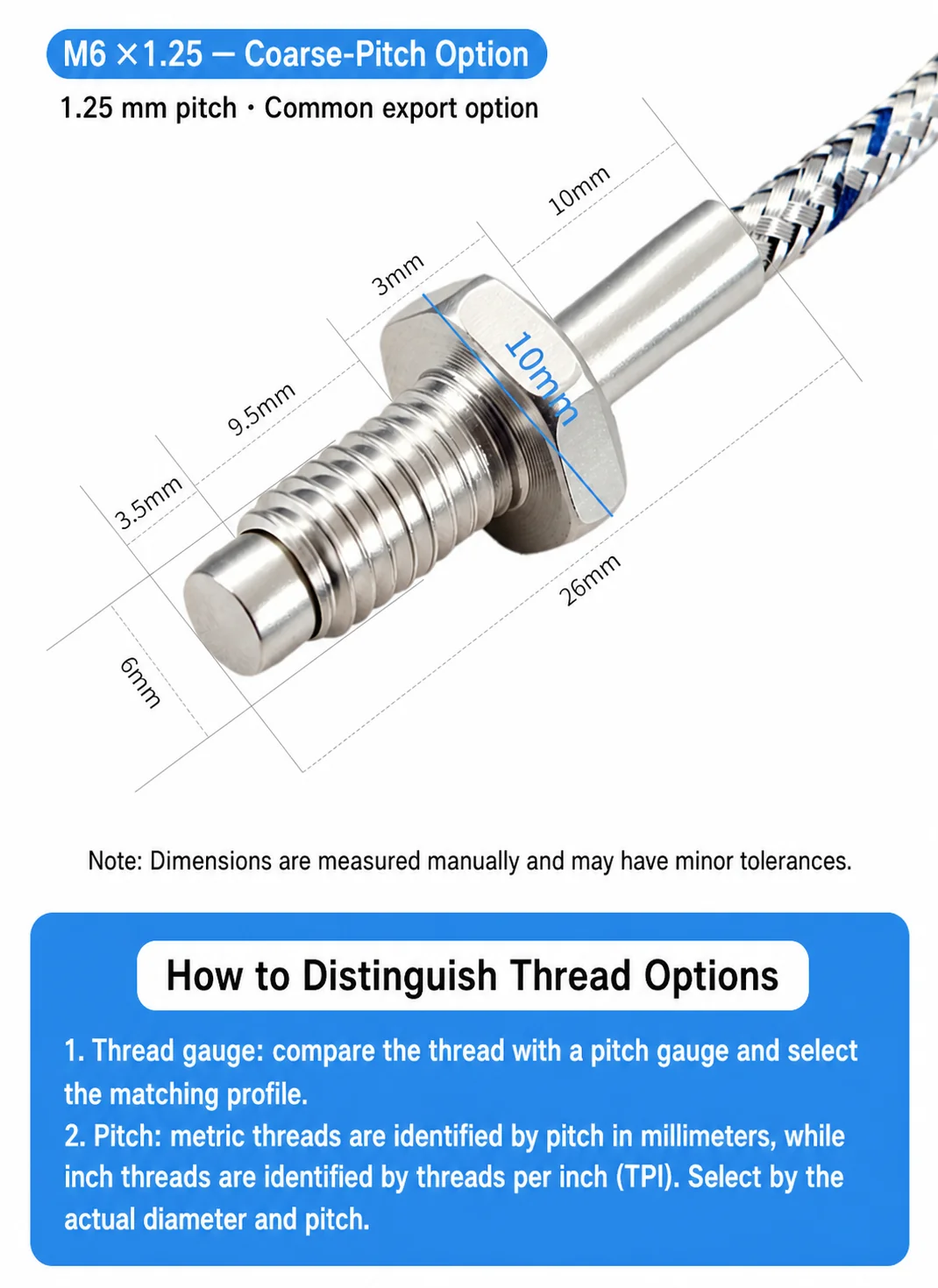
Both M6 versions share the same body dimensions: 6 mm probe tip, 9.5 mm threaded length, 10 mm hex across flats and 26 mm overall length. Dimensions are measured manually and may have minor tolerances.
- Seat the probe flat and firm against the surface, but do not over-torque. The reading depends on metal-to-metal contact area, not clamping force.
- Mount the probe where the heat actually is: on the heated surface, not on a bracket or cover a few millimetres away.
- A loose or air-gapped probe always reads low, which makes the controller overheat the process.
4. Probe construction
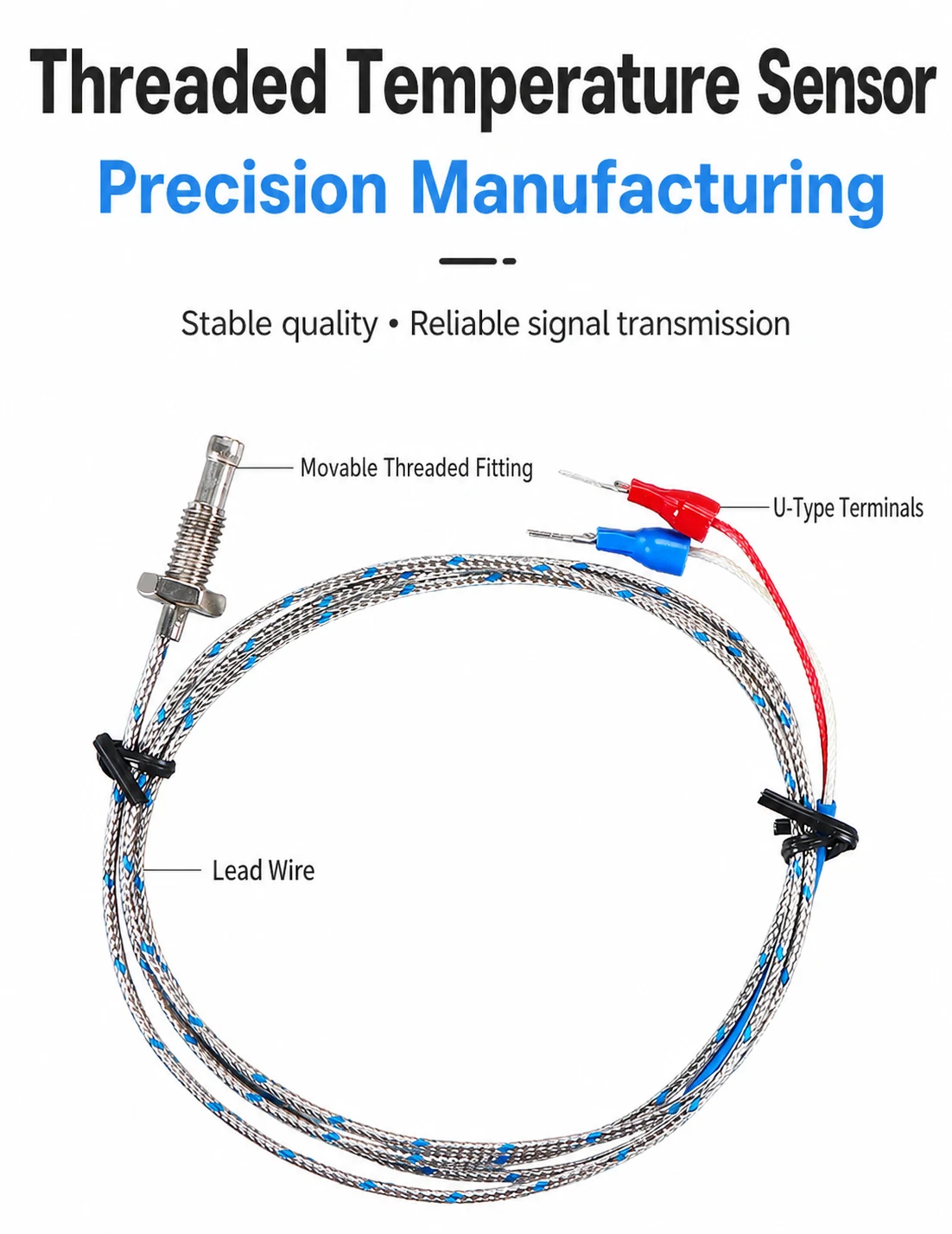
The threaded ring, the insulated element and the cable gland are assembled as a single sealed unit, so there is no exposed junction at the hot end and no path for oil or resin into the element.
5. Lead cable and shielding
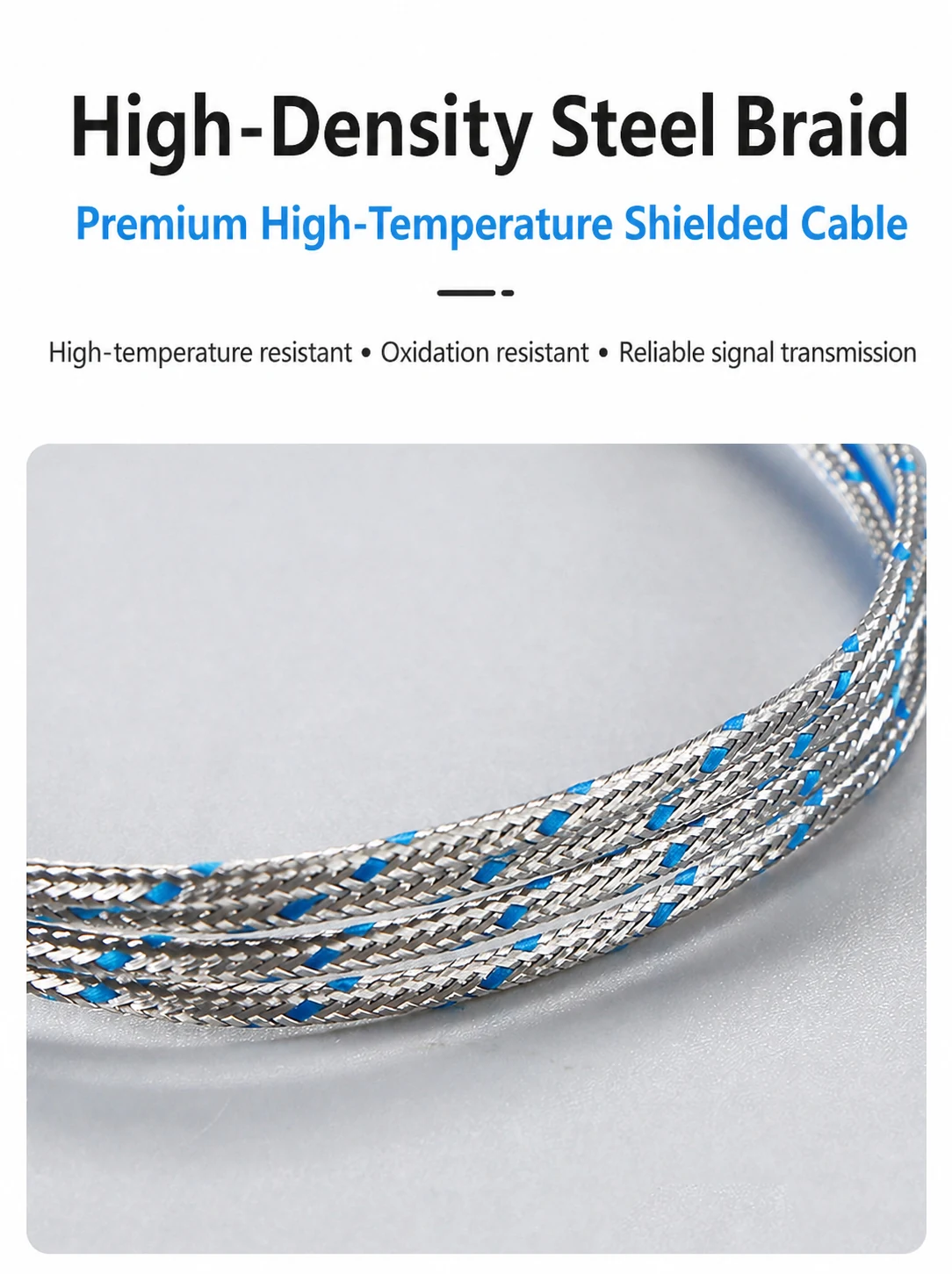
Use a braided high-temperature lead rather than PVC-insulated wire anywhere near a heater band: the braid resists abrasion where the cable crosses a machine edge, and the insulation tolerates the radiant heat. Where the sensor lead has to share a duct with the output cabling of a solid state relay or SCR power module, specify the shielded version and earth the shield at the controller end only.
6. Lead length
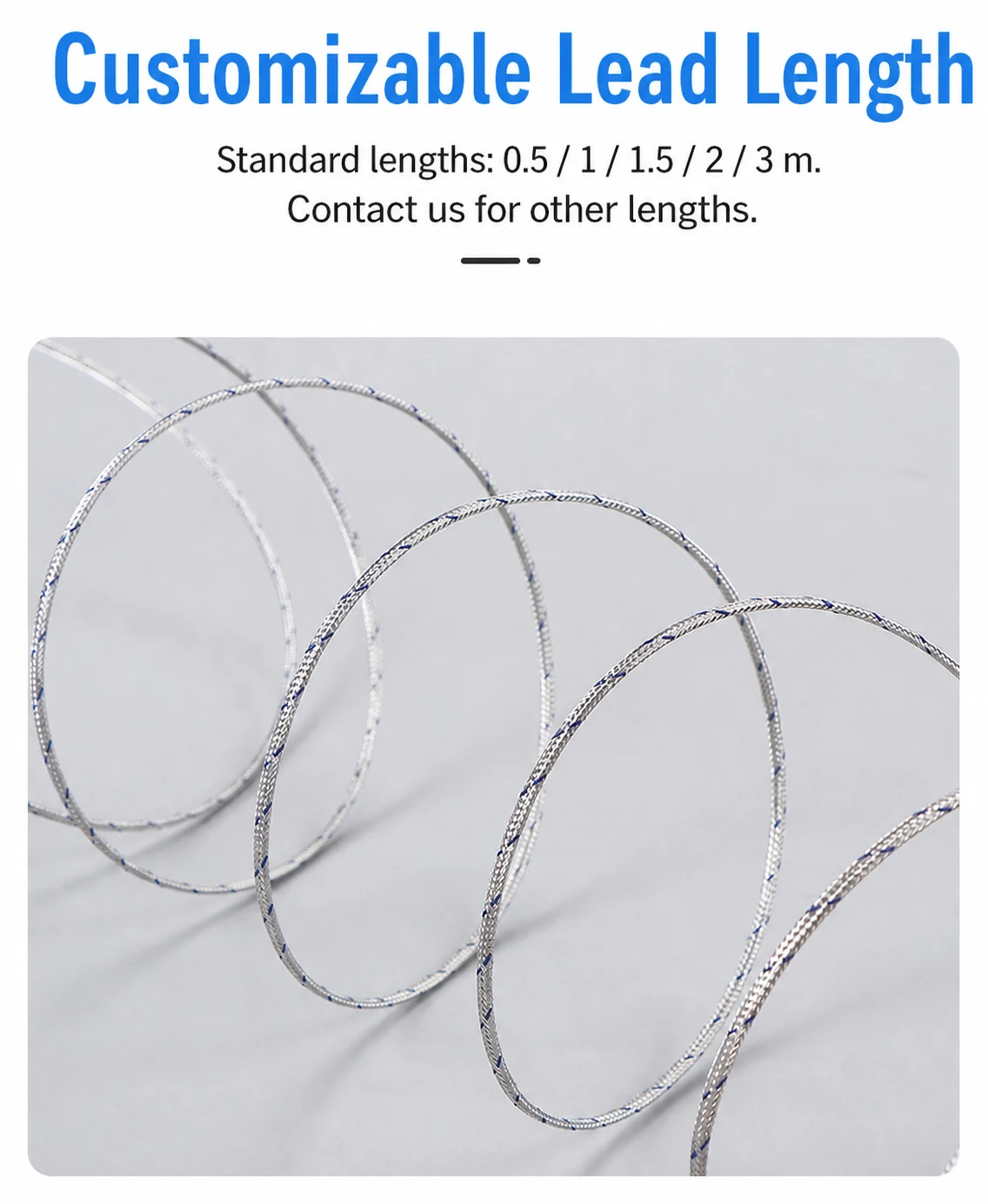
Standard lengths are 0.5, 1, 1.5, 2 and 3 m, with 0.2–5 m available to order. Measure from the probe to the controller terminal and allow slack for routing. Do not plan to extend the lead later with copper wire — a thermocouple extension needs matching compensation cable of the same type, and an RTD extension changes the lead resistance the controller has to compensate.
7. Terminals and polarity
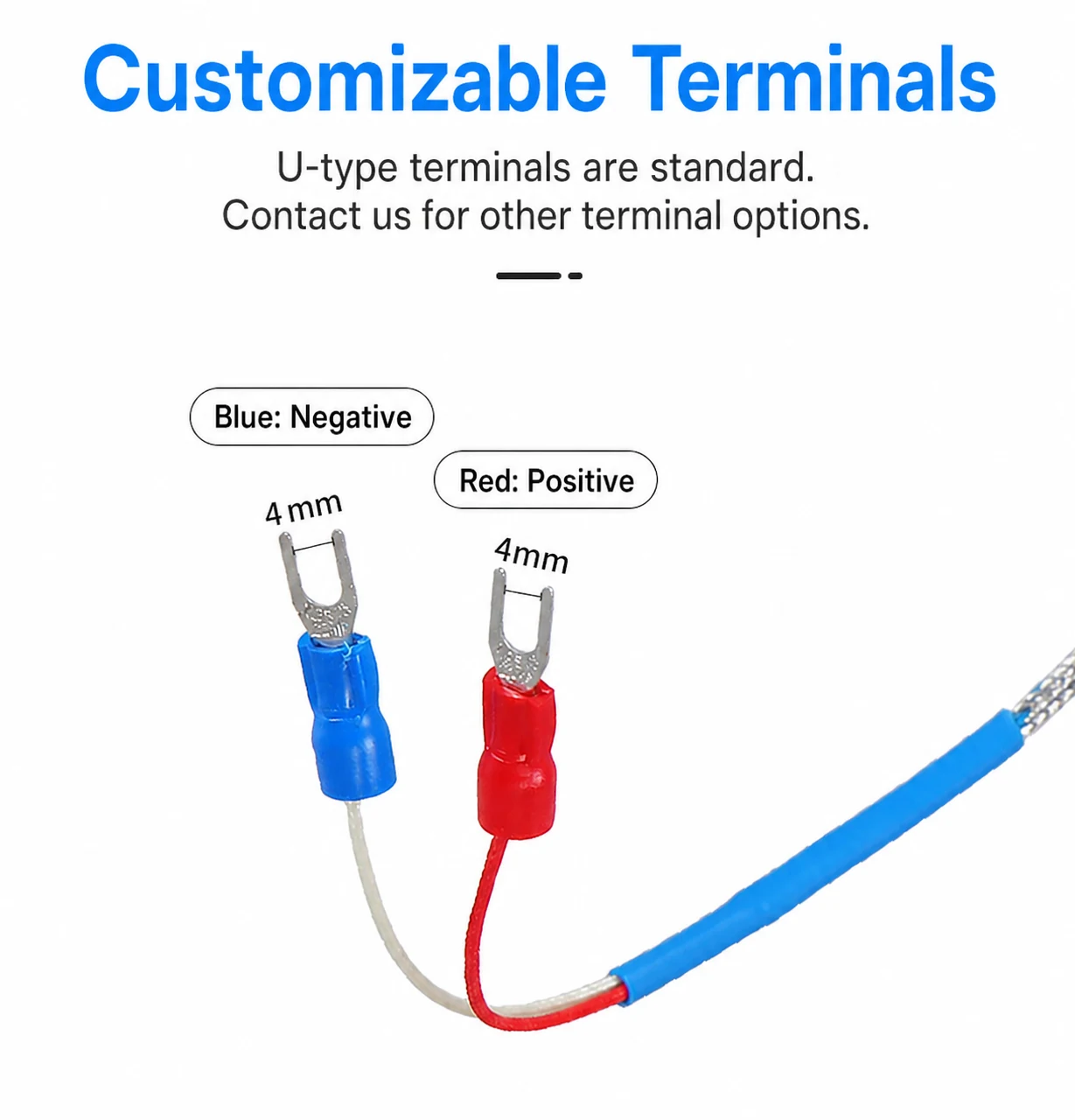
U-type crimped terminals land straight on the screw terminals of a PID temperature controller. Thermocouple polarity matters: if the reading falls as the process heats, the two leads are reversed. On a 3-wire Pt100, the odd-coloured lead is the compensation lead and belongs on the dedicated third terminal.
8. Commissioning checklist
- Controller input-type parameter matches the element fitted (K, E or Pt100).
- Probe seated flat and tight in a correctly threaded hole.
- Reading rises when the heater is switched on — if it falls, reverse the thermocouple leads.
- Sensor lead routed away from SSR / SCR load cables; shield earthed at one end only.
- Upper setpoint limit and over-temperature alarm set below the safe limit of the machine.
- PID auto-tune run at working temperature with the real load in place.
9. FAQ
Is Pt100 a thermocouple?
No. Pt100 is a platinum RTD read as a resistance through three leads; K and E are thermocouples that generate a millivolt signal. The controller input type must match the element fitted.
Which element should I choose for a heater band?
K type in most cases — 0–800 °C, low cost and supported by every controller. Choose Pt100 below 400 °C when accuracy matters, and E type when you want more output per degree up to 600 °C.
Does thread size affect accuracy?
Indirectly, through contact. The thread must match the tapped hole so the probe seats flat; a loose or cross-threaded probe reads low and lags the surface.
Can I extend the lead with ordinary copper wire?
No. Use matching compensation cable for a thermocouple, or order the finished length you need.
Technical support
Beijing Strong Electric manufactures thermocouple and RTD temperature sensors, PID temperature controllers and solid state relays and SCR power modules. For sensor selection or a custom build, email sales@strong-ele.com.