
Technical Guides · 2026-11-26
How to Choose a TCN4 Temperature Controller: Reading the Code Behind Size, Output and Range
The TCN4 order code carries five choices after a fixed prefix, and three of them — cutout, output build and alarm count — decide whether the unit fits the panel and drives the load. This guide reads each position, separates what the code does not tell you from what it does, and turns the answers into one order line.
Key points
- The TCN4 code has three fixed characters and five choices: size, alarm count, power supply, control output and an optional connector plug.
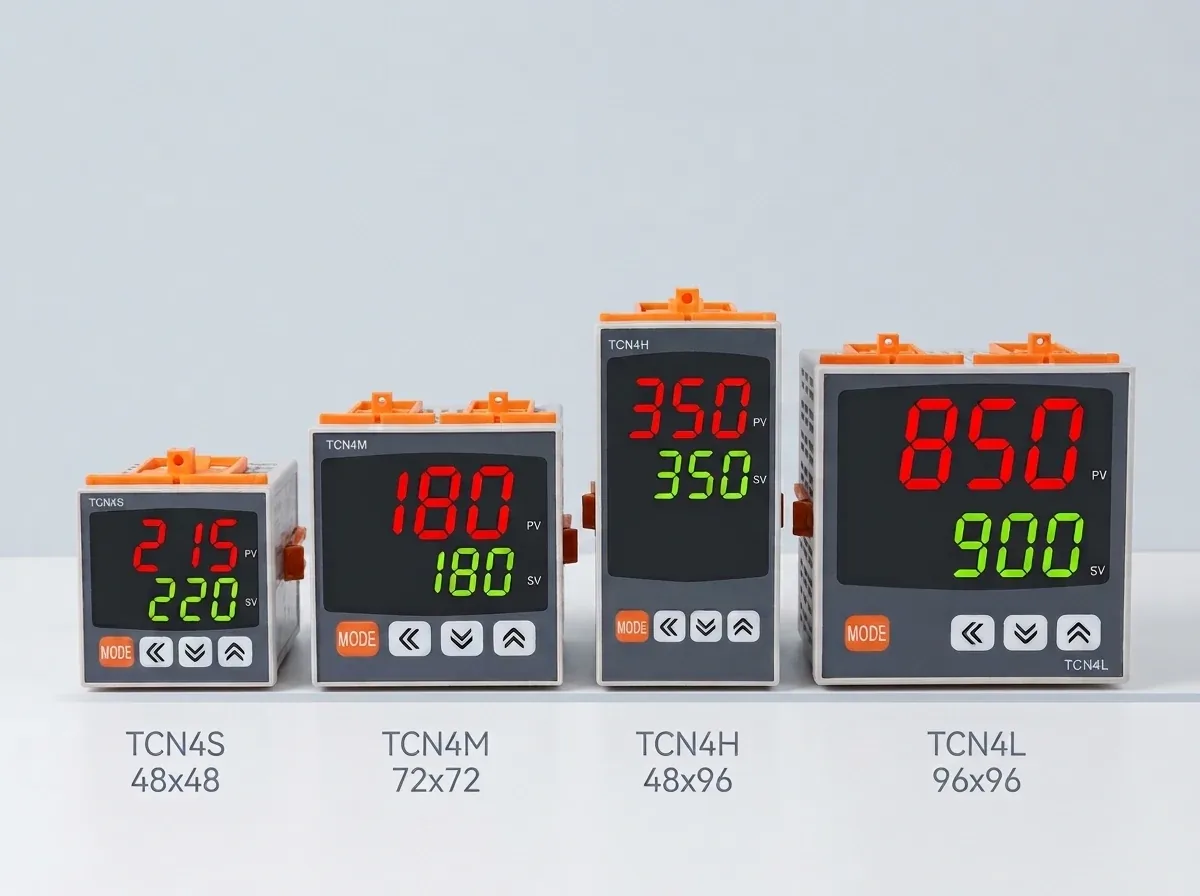
- The size letter is the only part of the code that fixes the panel cutout — 45 × 45, 68 × 68, 45 × 92 or 92 × 92 mm.
- Position four decides how the controller switches the load: relay contact, SSR drive, or both on one unit.
- Range and sensor type are not in the code. They are parameters, and the default 0–400 °C range is not the only one available at order.
- A code that reads correctly on paper can still arrive with the wrong alarm count — confirm it on the order, not on the label.
The TCN4 is a panel-mount digital PID temperature controller used on ovens, heat presses, extruders, packaging lines and small furnaces. Buyers rarely get into trouble over the control algorithm. They get into trouble at the order line: a front that will not fit the hole already cut in the door, an output build that cannot drive the contactor on the shelf, or a range that was assumed rather than specified.
This guide reads the code position by position, then covers the two things the code cannot tell you — range and sensor type — and finishes with the five answers that make an order unambiguous. Terminal-by-terminal wiring is a separate job and lives in the TCN4 contactor and SSR wiring guide.
Before ordering: measure the panel opening with a caliper, note the switching device already fitted (contactor, solid state relay or none), the heater voltage and power, the sensor type on the machine, and how many alarm contacts the process actually uses. Those five answers settle every position of the code.
1. What each position of the code selects
A TCN4 order code reads TCN4[SIZE][ALARM][POWER][OUTPUT]-[WIRING]. The first three characters never change on this family: T is the temperature controller, CN is the dual-display type set by touch switch, and 4 is the four-digit display, which reaches 9999. Everything a buyer chooses sits after that prefix.
| Position | Codes | What it fixes |
|---|---|---|
| 1 — Size | S / M / H / L | Front dimensions, panel cutout and terminal count |
| 2 — Alarm | 1 / 2 | One or two alarm outputs |
| 3 — Power | 2 / 4 | 24 VAC, 50/60 Hz or 24–48 VDC on 2; 100–240 VAC, 50/60 Hz on 4 |
| 4 — Output | RV / R / V | Relay contact plus SSR drive (RV), relay contact only (R), or SSR drive only (V) |
| 5 — Wiring | blank / P | Bolt terminals when left blank; connector plug on P, TCN4S only |
Two readings follow from that table and both catch buyers out. First, nothing in the code says what temperature the unit measures or what sensor it expects — those are parameters set in the menu after installation, and the default range is the reason a probe and a controller can disagree on arrival. Second, the last position is not a cosmetic option: a connector-plug body is a different rear housing, and on anything but a TCN4S the code simply does not exist.
2. Size fixes the cutout, not the display
The four fronts are not four display sizes with one mounting pattern between them. Each letter has its own opening, and the opening is the one thing on this job that cannot be adjusted after the door has been drilled.
| Code | Front | Panel cutout | Terminals |
|---|---|---|---|
| TCN4S | 48 × 48 mm | 45 × 45 mm | 12 |
| TCN4M | 72 × 72 mm | 68 × 68 mm | 14 |
| TCN4H | 48 × 96 mm | 45 × 92 mm | 14 |
| TCN4L | 96 × 96 mm | 92 × 92 mm | 14 |
All four bodies are 75 mm deep, so a shallow cabinet is not what decides the letter — the width and height of the opening are. The ABS housing is grey across the range, which matters only when a machine builder is matching an existing fascia.
The terminal count is the second consequence of the letter, and it is the one that hurts during commissioning rather than at the panel saw. The 12-terminal TCN4S and the 14-terminal M, H and L bodies number their terminals differently, so a drawing taken off an old TCN4S will not transfer to a TCN4H. Identify the model on the housing label before touching a wire; the two layouts are set out side by side in the wiring guide.
One practical note on retrofits: measure the hole rather than the bezel it currently holds. Doors get opened up for a larger front and the surplus is covered by the new bezel, so a 45 × 92 mm opening can sit behind what looks like a square 48 × 48 mm face. If the opening is larger than the front you are fitting, the mounting clips will not seal it and the panel loses its IP rating at that corner.
3. Output: RV, R, V and the current build
Position four is the decision most buyers actually agonise over, because it turns on what is already on the panel. The three codes are not quality tiers — they are three different interfaces to the power stage.
| Code | Output | Drives | Choose it when |
|---|---|---|---|
RV |
Relay contact + SSR drive | A contactor coil or a small resistive load, or an external solid state relay | The switching device is not settled yet, or a spare machine may be converted between the two |
R |
Relay contact only | A contactor coil, a solenoid valve or a small resistive load | The panel switches with a contactor and nothing else |
V |
SSR drive only | An external SSR, and through it the heater | A solid state relay is already specified and a mechanical contact would never be used |
The two outputs on an RV unit are on separate terminals and only one may be used at a time. Both are wired out because the body is built once for both markets; the controller drives one method, and the output-type parameter has to match the wiring actually installed. Wiring both and hoping is how a relay ends up chattering against an SSR signal.
A current-output build is listed separately as the 4–20 mA version and does not appear as a position-four code. It is a signal, not a switch: it goes to a SCR power regulator, a valve positioner or an analogue input, and it removes the converter you would otherwise fit between controller and power stage. It cannot feed a heater directly, and no amount of parameter editing changes that.
Two order mistakes account for most of the returns on this series. The first is an R unit bought for a panel that later gains a solid state relay — the money saved on the code is spent again on a replacement body. The second is the reverse: an RV unit wired to a contactor with the output parameter still set for SSR drive, which reads as a controller that "does not switch" when the load is in fact fine and the parameter is not. If the switching device is undecided, order RV; it is the only code that keeps both doors open.
4. Range and sensor type sit outside the code
No character in a TCN4 order code says 0–400 °C, and that is exactly why range is the assumption that survives longest. The 0–400 °C span is the default and covers the majority of heat presses, ovens, sealers and small furnaces; the 0–1200 °C and 0–1370 °C spans are selected at order and are what a kiln or a heat-treatment furnace needs.
A wider range is not free. Above the 0–400 °C band the probe stops being interchangeable: a general-purpose K thermocouple is the wrong part for a 1200 °C furnace, and the S, R or B types that belong there behave differently in the controller as well. Specify the range and the sensor together. Ordering the controller first and discovering the probe question afterwards is the second most expensive way to buy this instrument.
The input side is a menu setting, not a hardware option. The TCN4 accepts K, J, S, R and E thermocouples plus Pt100 and Cu50 RTDs, so one controller body can be moved between a thermocouple machine and an RTD machine. What it will not do is detect the sensor for you: the parameter has to be set before the first heat-up, and a unit left on a thermocouple setting with an RTD connected reads a plausible number that is wrong by tens of degrees.
- Thermocouple: two wires, and polarity matters. Reversed leads make the reading fall as the process heats — the classic symptom of a swapped pair.
- Pt100 or Cu50: three wires. The single red conductor goes to the compensation terminal and the other two can be fitted in either order.
- Extension runs: use compensating cable of the same thermocouple type. Ordinary copper introduces a junction error that no amount of tuning removes.
Display resolution is 0.1 °C, which is finer than the ±0.5% FS accuracy class behind it. That is normal for this instrument class and worth remembering when a customer reports the display "jumping by a degree": the number is honest, the tolerance is wider than the last digit.
5. Alarm count and the supplier example that misreads it
Position two is the shortest choice in the code and the one most often left to chance. 1 gives one alarm output, 2 gives two. The alarm is an upper or lower limit contact, independent of the control output, and it is what drives an over-temperature beacon or an interlock — it is not a substitute for a hardwired safety thermostat, and treating it as one is a design error rather than a selection error.
One caution belongs here because it is printed in the supplier's own selection sheet: its worked examples read TCN4S-24RV as "one alarm" while the legend defines 2 in that position as the two-alarm code. The same sheet prints the output letter as R in its examples while the legend defines R as relay contact only, and RV as relay plus SSR drive. Both readings cannot be right. Read the positions by the legend, write the code out in full on the order — size, alarm count, supply, output — and confirm the alarm count back in writing. A wrong alarm count is invisible until the beacon that was supposed to light does not.
6. Writing the order line
Five answers close the order. None of them is about control theory.
| Question | Settles |
|---|---|
| What is the panel opening, measured? | The size letter, and with it the terminal count |
| How will the load be switched — contactor, SSR, or both? | Position four, between RV, R, V and the current build |
| What is the highest process temperature? | The range, and whether the probe has to change with it |
| Which sensor is on the machine? | The input parameter set at commissioning |
| How many alarm contacts does the process use? | Position two, and the alarm wiring |
Written out, an order line looks like this: TCN4M-24RV, 72 × 72 mm front on a 68 × 68 mm cutout, two alarms, 100–240 VAC supply, relay contact plus SSR drive, bolt terminals; 0–400 °C range with a K thermocouple; contactor switching a 3 kW heater at 220 V. Every one of those clauses maps to a position in the code or to a setting the factory has to know before the unit ships — none of them is decoration.
If you are replacing a controller rather than building a panel, photograph the old nameplate and measure the opening before ordering anything. The nameplate usually settles the size, supply and output; the caliper settles whether the previous fitter opened the door wider than the front that is in it.
7. FAQ
What is the difference between TCN4S, TCN4M, TCN4H and TCN4L?
Panel size, cutout and terminal count. TCN4S is the 48 × 48 mm front with a 45 × 45 mm cutout and 12 terminals; TCN4M is 72 × 72 mm on a 68 × 68 mm cutout; TCN4H is 48 × 96 mm on a 45 × 92 mm cutout; TCN4L is 96 × 96 mm on a 92 × 92 mm cutout. The three larger bodies carry 14 terminals. All four are 75 mm deep and share the same parameter set.
Should I order the RV, R or V output?
RV if you want both a relay contact and an SSR drive output available on the same unit — the usual choice, because the switching device can be decided at the panel rather than at the order. R if the load will only ever be switched by a contactor coil or a small resistive load. V if a solid state relay is already specified and a mechanical contact would never be used.
The panel already has a hole cut. Which model do I order?
Measure the opening, not the old bezel. A fitter may have cut the door for a larger front and covered the surplus, so the visible square tells you less than a caliper does. 45 × 45 mm takes TCN4S, 68 × 68 mm takes TCN4M, 45 × 92 mm takes TCN4H and 92 × 92 mm takes TCN4L.
Can a TCN4 run above 400 °C?
The 0–400 °C range is the default and the one stocked for K-type work. The 0–1200 °C and 0–1370 °C ranges are selected at order, and they only make sense with a thermocouple that survives the temperature — S, R or B types rather than a general-purpose K probe. Order the range and the sensor together, not the controller first and the probe later.
Can the 4–20 mA build drive a heater directly?
No. The current loop is a signal for a SCR power regulator, a valve positioner or a PLC analogue input. It carries information, not load current. What it saves is the signal converter you would otherwise fit between the controller and the power stage.
8. Selection support
Beijing Strong Electric manufactures PID temperature controllers, solid state relays and SCR power modules and thermocouple and RTD sensors. The published TCN4 specification is on the TCN4 product page, and terminal-by-terminal methods are in the contactor and SSR wiring guide.
Send the measured cutout, the switching device, the highest process temperature, the sensor type and the alarm count, and the code comes back unambiguous. Email sales@strong-ele.com or contact us for a selection check against an existing panel.