
Temperature Controllers
WSK-Z Series Temperature and Humidity Controller
WSK-Z temperature and humidity controller for LV switchgear, switching a heater and a dehumidifier to hold enclosures above the dew point.

- Panel size
- 48×48mm (WSK-ZG) / 72×72mm (WSK-ZD)
- Panel cutout
- 45×45mm (WSK-ZG) / 68×68mm (WSK-ZD)
- Supply voltage
- 220VAC, 50/60Hz, with a 380VAC build
- Temperature range
- 0–99.9°C, with a sensor housing that should not sit above 70°C for long
Technical specifications
| Series | WSK-Z — temperature and humidity controller with anti-condensation control, for the inside of a switchboard rather than for a process |
|---|---|
| Models | WSK-ZG 48×48 flush or on an 8-pin base; WSK-ZD 72×72 flush, also sold under the code TDK0302 |
| Function | Reads cabinet temperature and humidity and switches a heater and a fan or dehumidifier at adjustable upper and lower limits, so the air stays above the dew point and condensation does not form on busbars and terminals |
| Display | Two 3-digit red LED rows — temperature in °C above, humidity in %RH below — with T, RH and A/M indicators |
| Temperature range | 0–99.9°C, with a sensor housing that should not sit above 70°C for long |
| Humidity range | 0–99.9%RH |
| Accuracy | ±0.5°C / ±3%RH, resolution 0.1°C and 0.1%RH on the WSK-ZG; the WSK-ZD is quoted at 0.3°C / 4.5%RH |
| Control output | One relay for temperature and one for humidity, each switching at its own upper and lower limits (on/off control with an adjustable differential) |
| Relay contact rating | 3A at 220–250VAC, resistive |
| Load per channel | 600W maximum; switch a contactor above that rather than the heater direct |
| Supply voltage | 220VAC, 50/60Hz, with a 380VAC build |
| Power consumption | ≤1.5W (WSK-ZG) / <2W (WSK-ZD) |
| Sensor | Remote temperature and humidity probe on a four-wire lead, supplied with the instrument, so the reading is taken in the air of the cabinet rather than behind the panel |
| Panel size | 48×48mm (WSK-ZG) / 72×72mm (WSK-ZD) |
| Panel cutout | 45×45mm (WSK-ZG) / 68×68mm (WSK-ZD) |
| Depth behind panel | 80mm (WSK-ZG) / 90mm (WSK-ZD) |
| Communication build | Both bodies are available with a serial communications board — ordered as the communication version, and then the address and baud rate are set from the front keys |
| Mounting | Flush, held by the two clips supplied; the WSK-ZG is also offered on an 8-pin base so a failed unit can be swapped without touching the wiring |
| Manual override | The A/M key forces either output on or off for commissioning, with the A/M indicator lit |
| Parameter retention | Settings held after power-off |
| Typical use | Outdoor terminal boxes, LV and HV switchgear, withdrawable (handcart) cubicles, ring-main units, underground substations, breaker mechanism boxes and instrument cabinets |
| Certification | CE |
Product overview
Part no. SE-WSK-Z
Also known as: WSK-Z temperature and humidity controller · switchgear anti-condensation thermostat
An anti-condensation controller for the inside of a switchboard, not for a process. It reads cabinet temperature and humidity on two three-digit displays and closes a relay when either value crosses its limit — one channel for the heater, one for the fan — so the enclosure is warmed before the air reaches the dew point and ventilated once it has. Each relay carries 600W; anything larger has to go through a contactor. The probe hangs on a lead in the air of the cabinet, which is the air that actually condenses, and the 72×72mm WSK-ZD and 48×48mm WSK-ZG cover the two cut-outs a panel shop already has.
Key features
- Temperature and humidity on separate displays, each channel with its own upper and lower limit — set independently, not derived from one another.
- 3A at 220–250VAC, resistive per relay and 600W per channel, so a bigger heater goes through a contactor rather than through the instrument.
- 72×72mm with a 68×68mm cut-out, and 48×48mm with a 45×45mm cut-out — the same instrument fits either hole.
- The WSK-ZG is also offered on an eight-pin base, so a failed unit is swapped without touching the wiring of a cabinet that is already in service.
- The A/M key forces either output on for commissioning, and the settings survive a power cut.
Works with
The parts that go into the same panel and are usually ordered with it.
Compatible sensors & outputs
also supplied as switchgear temperature and humidity controller, cabinet anti-condensation thermostat
| Sensor | Range | Available as |
|---|---|---|
| Temp / RH | Dedicated cabinet temperature & humidity sensor (supplied with controller) |
Output types and what goes with them
| Output | Rating | Order with it |
|---|---|---|
| Relay contact output | Switches anti-condensation cabinet heaters or cooling fans; use a contactor for high-power loads | CJX2 AC contactor |
Three versions at a glance
Same temperature & humidity controller in three housings: 72×72mm (ZD), 48×48mm flush (ZG), or 48×48mm plug-in base for fast swaps without unwiring.
| WSK-ZD | WSK-ZG flush | WSK-ZG base | |
|---|---|---|---|
| Front bezel | 72×72mm | 48×48mm | 48×48mm |
| Panel cut-out | 68×68mm | 45×45mm | 45×45mm |
| Depth behind panel | 90mm | 80mm | 80mm + socket |
| Mounting | Flush, two clips | Flush, two clips | 8-pin plug-in base |
| Accuracy (T / RH) | 0.3°C / 4.5%RH | ±0.5°C / ±3%RH | ±0.5°C / ±3%RH |
| Consumption | < 2W | ≤ 1.5W | ≤ 1.5W |
| Load per channel | 600W max | 600W max | 600W max |
Panel cut-out & wiring
Bezel overlaps the hole by 2mm per side (72→68mm, 48→45mm). Leave 80–90mm clear depth behind the panel.
Show terminal tables for WSK-ZG (10-way), WSK-ZD (14-way) & 8-pin base
WSK-ZG 48×48 (10-way)
| 1 | Probe, blue | 3.3V |
| 2 | Probe, brown | SDK, data |
| 3 | Not used | — |
| 4 | Probe, white | SCL, clock |
| 5 | Probe, black | GND |
| 6 | Supply L | 220VAC |
| 7 | Supply N | 220VAC |
| 8 | Common of both contacts | Feed from 6 (L) |
| 9 | Temperature relay, NO | 600W max |
| 10 | Humidity relay, NO | 600W max |
WSK-ZG Base (8-pin)
| 1 | Supply L | 220VAC |
| 2 | Supply N | 220VAC |
| 3 | Probe, blue | 3.3V |
| 4 | Probe, brown | SDK, data |
| 5 | Probe, white | SCL, clock |
| 6 | Probe, black | GND |
| 7 | Humidity relay output | 600W max |
| 8 | Temperature relay output | 600W max |
WSK-ZD 72×72 (14-way)
| 1 | Humidity relay, NO | Load side |
| 2 | Humidity relay, COM | Linked to 3 |
| 3 | Humidity relay, NC | Strapped to 2 |
| 4 | Probe, blue | 3.3V |
| 5 | Probe, brown | SDK, data |
| 6 | Probe, white | SCL, clock |
| 7 | Probe, black | GND |
| 8–9 | Supply 220VAC | Either way |
| 10–11 | Not used | — |
| 12 | Temperature relay, NO | Load side |
| 13 | Temperature relay, COM | Linked to 14 |
| 14 | Temperature relay, NC | Strapped to 13 |
Digital 4-wire probe (blue/brown/white/black) cannot be swapped with Pt100/NTC. Max 600W per relay — use a contactor for larger heaters.
Wiring
Five panels: the WSK-Z in its panel-mount and socket-mount forms, each with the electrician's schematic that goes beside it, and the TDK0302 that switches two contactors. The socket version is wired the same way but numbered differently, so read the panel that matches the body you have.
WSK-Z / TDK0302 · wiring diagrams and schematics
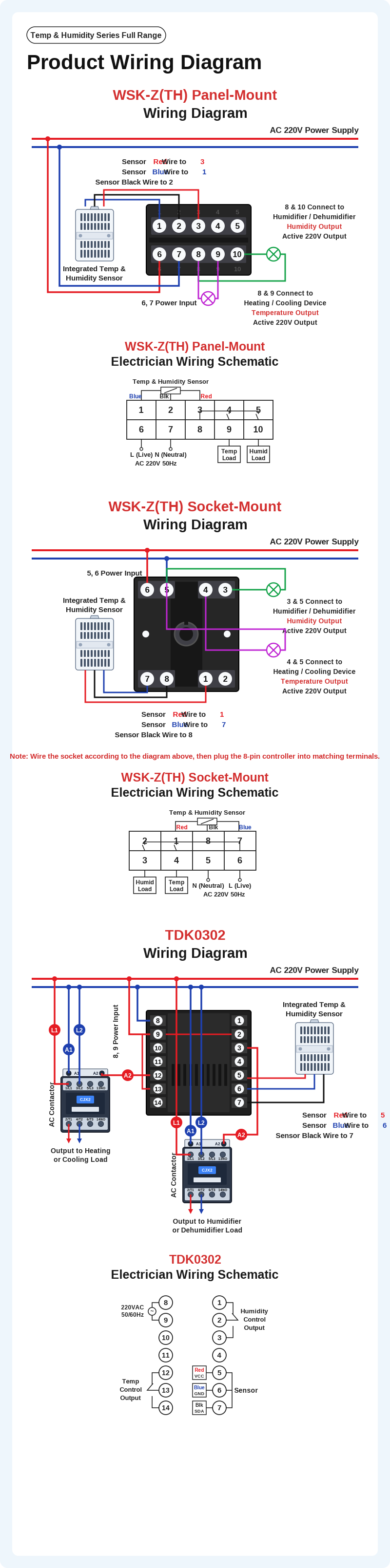
Sensor leads carry their own colours on both WSK-Z bodies: red to the signal terminal, blue to the supply side of the sensor pair, black to the common. On the socket version, wire the socket first and then plug the controller into it — the numbers on the socket and on the controller are not the same.
Documents for this family
- WSK-Z / TDK0302 wiring151 KB · 2026-11-18
Supply & OEM
- Stock / sample dispatch
- Typically 3–5 working days for available stock models after stock and order confirmation
- Warranty
- 3 years
- OEM
- Selected models; confirm by quotation
- Shipping
- Worldwide export
Frequently asked questions
Which of the two — WSK-ZD or WSK-ZG — should I specify?
The cut-out decides it first: the WSK-ZD needs 68 × 68 mm behind a 72 mm front, the WSK-ZG 45 × 45 mm behind a 48 mm front. If either hole will do, the ZG is the more accurate of the two (±0.5 °C and ±3 %RH against 0.3 °C and 4.5 %RH) and uses less power. Take the base version of the ZG where a unit may have to be swapped on a live board without disturbing the wiring.
What is the probe, and can I fit a different one?
It is a digital sensor, not a resistive element: the four wires are 3.3 V, data, clock and ground, and the instrument reads it over that bus. A Pt100 or NTC cannot be substituted, because the input is not measuring resistance. The probe comes with the instrument on a lead, which is the point — it hangs in the air of the cabinet, where the condensation actually forms, rather than sitting behind the panel where the instrument is.
Why control humidity as well as temperature?
Because a heater alone cannot cover the year. Heating raises the air temperature and drops its relative humidity, which is enough on a cold night, but in summer the heater is off and a sealed cabinet still swings with the ambient — and a sudden drop, or a cold front arriving at a warm cabinet, takes the air through the dew point. The second channel runs a fan or a dehumidifier for that half of the year, so the same instrument covers both seasons.
Some references quote 10 A but the rating plate says 3 A. Which is right?
The 3 A. The per-model rating is 3 A resistive with a 600 W load per channel, and that is the figure published here; a 10 A claim is a template value that does not apply to this model. A resistive heater draws a large inrush when cold, so leave headroom below 600 W or switch a contactor — a relay that welds closed holds the heater on.
Related guides
TEL96-9001 or TEL96-2001: Choosing the Right Oven Temperature Controller
The TEL96 series is a 96 x 96 mm on/off oven temperature controller built around a K-type thermocouple input and a 10 A relay contact. It is made in two versions, the TEL96-9001…
Read guide Technical Guides · 2026-08-23How to Wire REX-C100, REX-C700 and REX-C400/C900 Temperature Controllers
English wiring diagrams for REX-series temperature controllers, including relay, AC contactor, SSR, K-type thermocouple and 3-wire PT100 connections.
Read guide Technical Guides · 2025-05-31TC5 Setup Guide: PT100 Input, Decimal Display and 45–50°C Range Control
Setup guide for the TC5 series temperature controller, covering PT100 input selection, decimal display resolution and 45–50°C hysteresis range control.
Read guideRelated models
All Temperature Controllers
THE-2000 / THF-2000 / THD-2000 Temperature and Time Controller
SE-THE2000
One instrument for the two settings a heat press actually needs: platen temperature and dwell time. The temperature is held by PID to ±1.0%FS over…
View details
EW-181 Digital Temperature Controller — Cooling / Heating
SE-EW-181
The EW-181H is a compact snap-in digital temperature controller for simple ON/OFF cooling or heating. It reads the NTC probe supplied with the unit,…
View details
WK-P / WSK-P Panel Temperature and Humidity Controller
SE-WK-P
48×48mm (1/16 DIN) · 45×45mm · 100mm on the base-socket body, 93mm on the flush body
View details
REX-C100/C400/C700/C900 Digital PID Temperature Controller
SE-C100
REX Series Digital PID Temperature Controller is a classic and reliable industrial temperature control instrument designed for heating, cooling, and…
View detailsNeed help selecting the right model?
Send us the load, voltage, sensor type and output signal. We reply with the matching model, wiring notes and an OEM quotation.