
Temperature Controllers
96 Series, 0–900 °C, with timer
The 0–900 °C build, with the timer function fitted. Same 96 × 96 mm (1/4 DIN) case, same 30A contact and the same front-panel lock as every other line in the range — what changes is where the controller stops reading and the timer starts.

- Output
- 30A relay contact, plus the timer
- Bezel
- 96 × 96
- Panel cut-out
- 92 × 92
Technical specifications
| Series | 96 Series (96mm square-bezel temperature controller, with or without timer) |
|---|---|
| Models | 0–300°C, 0–600°C and 0–999°C, each with or without the timer function |
| Display | Digital LED, PV and SV |
| Control method | PID with auto-tuning, ON/OFF |
| Input | K and E thermocouple |
| Temperature range | 0–300°C, 0–600°C or 0–999°C by model |
| Control output | Relay contact |
| Relay contact rating | 30A contact, 4500W resistive load |
| Parameter lock | Front-panel data lock, so settings cannot be changed by operators |
| Supply voltage | 220VAC, 50/60Hz |
| Accuracy (listing) | ±1°C |
| Accuracy (supplier card) | ±0.5%FS |
| Power consumption | <30VA |
| Insulation strength | 150VAC for 1 minute |
| Response time | 5s |
| Panel size | 96×96mm (1/4 DIN) |
| Panel thickness | 28mm bezel, 25mm into the panel |
| Panel cutout | 92×92mm |
| Dimensions (depth) | 58mm behind the bezel |
| Weight | 0.198kg |
| Mounting | Panel mount, flush bezel |
| Certification | CE |
Product overview
Part no. SE-TC-96X96industry model TC-96X96
Also known as: 96×96mm 30A temperature controller · oven timer temperature switch
This 96×96mm (1/4 DIN) controller comes in six versions: 0–300°C, 0–600°C or 0–999°C, each with or without a timer. The front-panel data lock is the feature that matters on a production machine — once the setpoint is locked an operator cannot change it without the key sequence, so a shift change cannot shift the process. Output is a 30A relay, ±1°C accuracy, and the case is 58mm deep, which leaves room in a shallow enclosure.
Ordering code
96 Series, 0–900 °C, with timer
The 0–900 °C build, with the timer function fitted. Same 96 × 96 mm (1/4 DIN) case, same 30A contact and the same front-panel lock as every other line in the range — what changes is where the controller stops reading and the timer starts.
| Order code | 96 Series, 0–900 °C, with timer |
|---|---|
| Bezel (mm) | 96 × 96 |
| Cut-out (mm) | 92 × 92 |
| Output | 30A relay contact, plus the timer |
| Output terminals | as marked on the case |
| Input | K or E thermocouple, fixed in the build |
| Alarm | No alarm relay; the second lamp is the timer |
| Supply | 220VAC, 50/60Hz |
What it can switch: One 30A contact, rated for a 4,500W resistive load — wide enough to switch a dryer or oven element directly rather than a contactor coil, which is what the 10A builds of this size cannot do
Terminals follow the diagram printed on the side of the instrument; if the unit you receive carries a different numbering, that diagram takes precedence.
Other output stages of the same bezel
Reading this order code
How the code on this page is put together, part by part — the same breakdown the series page gives, filled in for this version.
| Position | Reads | Meaning |
|---|---|---|
| bezel | 96 × 96 | Square 96mm front on a 92 × 92mm cut-out — the largest of the DIN panel sizes, so the digits read from across a machine |
| range | 0–900 °C | Full scale 900 °C on a K or E thermocouple. The supplier sells the range as part of the SKU rather than as an option on one SKU, so order the range you need by name |
| timer | with timer | The timer stage is fitted, so the same unit can hold a dwell time as well as a temperature |
| output | 30A relay | One electromechanical contact rated 30A, which is what lets it switch an element directly instead of a contactor coil |
How this build compares with the others
Same case, same cut-out, same supply. The differences are the ones below.
| Order code | Output stage | What it can switch | Terminals |
|---|---|---|---|
| 96 Series, 0–900 °C, with timerthis page | 30A relay contact, plus the timer | One 30A contact, rated for a 4,500W resistive load — wide enough to switch a dryer or oven element directly rather than a contactor coil, which is what the 10A builds of this size cannot do | as marked on the case |
| 96 Series, 0–300 °C, no timer | 30A relay contact, control output only | One 30A contact, rated for a 4,500W resistive load — wide enough to switch a dryer or oven element directly rather than a contactor coil, which is what the 10A builds of this size cannot do | as marked on the case |
| 96 Series, 0–600 °C, no timer | 30A relay contact, control output only | One 30A contact, rated for a 4,500W resistive load — wide enough to switch a dryer or oven element directly rather than a contactor coil, which is what the 10A builds of this size cannot do | as marked on the case |
| 96 Series, 0–999 °C, no timer | 30A relay contact, control output only | One 30A contact, rated for a 4,500W resistive load — wide enough to switch a dryer or oven element directly rather than a contactor coil, which is what the 10A builds of this size cannot do | as marked on the case |
| 96 Series, 0–300 °C, with timer | 30A relay contact, plus the timer | One 30A contact, rated for a 4,500W resistive load — wide enough to switch a dryer or oven element directly rather than a contactor coil, which is what the 10A builds of this size cannot do | as marked on the case |
| 96 Series, 0–600 °C, with timer | 30A relay contact, plus the timer | One 30A contact, rated for a 4,500W resistive load — wide enough to switch a dryer or oven element directly rather than a contactor coil, which is what the 10A builds of this size cannot do | as marked on the case |
Key features
- Front-panel data lock so operators cannot change the setpoint
- 0–300°C, 0–600°C or 0–999°C, each with or without a timer
- 30A relay output
- ±1°C accuracy
- 96×96mm front, 92×92mm cutout
- 58mm case depth
- K and E thermocouple input
- CE marked
Works with
The parts that go into the same panel and are usually ordered with it.
Panel breakdown
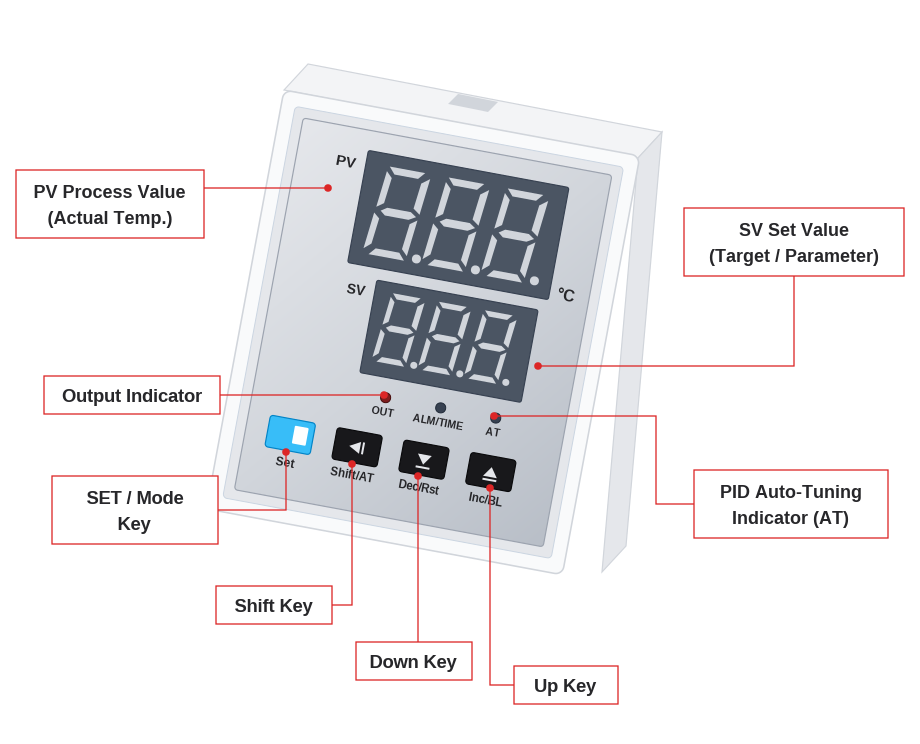
Swipe the drawing sideways to see all of it.
PV
Process value
The upper row, three digits. This is the temperature the thermocouple is reading at this moment, not the target — on a cold start it climbs from ambient to the set point over the first minutes of the cycle.
SV
Set value
The lower row. Normally the target temperature; while a parameter is open it shows that parameter's value instead, which is why the legend calls it target or parameter.
°C
Unit
Printed once, beside the upper row. The specification states degrees Celsius only, so both rows read in the same unit and there is no unit switch to set.
OUT
Output lamp
Lit while the relay is closed and the element is being driven. Under PID the lamp pulses: the closer the process sits to the set point, the shorter the on time, so a steady glow means the loop is asking for full power.
ALM/TIME
Alarm or timer lamp
One lamp with two legends on it. These builds are specified with a single control relay and no alarm output, so the lamp is read as the timer lamp on the versions that carry the timer; the ALM half of the legend comes from the same moulding, not from a function this range lists.
AT
Auto-tuning lamp
Lit while PID auto-tuning is running. It goes out once the controller has derived its P, I and D values from the process it just watched, and starts controlling with them.
Set
SET / Mode key
Opens the parameter list and steps to the next parameter; on the last one it returns to the run display. The key is printed in the lighter colour because it is the one an operator presses first.
Shift/AT
Shift and auto-tune key
Moves the digit being edited, which is how a four-figure parameter is set without pressing the up key a hundred times. The AT half starts auto-tuning from the run display.
Dec/Rst
Down and reset key
Lowers the value. The second function is printed as Rst; the supplier's sheet does not spell out what it resets, so confirm it on the unit before a recipe depends on it.
Inc/BL
Up and backlight key
Raises the value. BL is printed as the second function; the specification lists no display backlight, so that half stays unconfirmed until the unit is in hand.
Front-panel data lock
The lock is set from the front panel itself. With it on, an operator cannot change the set point without the unlock sequence, so a change of shift does not change the process — which is what puts this controller on a production machine rather than on a test bench.
One page per order code
Every code this family ships, with the bezel, the output stage and the terminals that output uses.
96 Series
96 × 96mm (1/4 DIN) · cut-out 92 × 92mm
Compatible sensors & outputs
also supplied as 96×96 mm 30A oven temperature controller, digital temperature and timer switch
| Sensor | Range | Available as |
|---|---|---|
| K | 0–300 / 0–600 / 0–999 °C (by ordered version) | K / E probe thermocoupleStainless steel probeThreaded shielded-lead probe |
Output types and what goes with them
| Output | Rating | Order with it |
|---|---|---|
| High-current relay | 250 VAC / 30 A resistive contact; use an external contactor for heavy inductive or three-phase loads | CJX2 AC contactor |
Supply & OEM
- Stock / sample dispatch
- Typically 3–5 working days for available stock models after stock and order confirmation
- Warranty
- 3 years
- OEM
- Selected models; confirm by quotation
- Shipping
- Worldwide export
Frequently asked questions
What panel size and cut-out does the 96 Series need?
96×96mm (1/4 DIN). The cut-out is 92×92mm
Which sensors can the 96 Series read?
K and E thermocouple
What output options does the 96 Series have?
Relay contact
What supply voltage does the 96 Series need?
220VAC, 50/60Hz
How accurate is the 96 Series?
±1°C
What is the temperature range?
0–300°C, 0–600°C or 0–999°C by model
Related guides
TEL96-9001 or TEL96-2001: Choosing the Right Oven Temperature Controller
The TEL96 series is a 96 x 96 mm on/off oven temperature controller built around a K-type thermocouple input and a 10 A relay contact. It is made in two versions, the TEL96-9001…
Read guide Technical Guides · 2025-04-15How to Wire REX-C100/C400/C700 Temperature Controllers with Relay and SSR Output
This blog provides a comprehensive guide on wiring REX series temperature controllers, including the C100, C400, and C700 models. It explains both relay and solid-state relay…
Read guide Product Updates · 2025-04-11TCN4 Series PID Temperature Controller: Model Codes, Inputs, Outputs and Commissioning
A working reference for engineers specifying or commissioning a TCN4 series digital PID temperature controller: how the four panel sizes differ, which sensor inputs are accepted,…
Read guideRelated models
All Temperature Controllers
SCR-100 / ZKG-2000 Blow Molding Machine Heating Controller
SE-100
The SCR-100 / ZKG-2000 is a panel-mount heating controller for blow molding and thermoforming machines — not a standard PID temperature controller.…
View details
TC3 Series Temperature & Time Controller — TC3-401T / TC3-501T / TC3-701T
SE-TC3-401T
TC3 Series Temperature and Time Controller is designed for heat press machines, sublimation machines, hot stamping machines, leather embossing…
View details
TS400 Temperature, Time & Count Controller — 48×96mm
SE-TS400
48×96mm (1/8 DIN) · 45×92mm · 85mm behind the bezel
View details
TS600 Touch Screen Temperature Controller — 72×72mm
SE-TS600
72×72mm · 68×68mm
View detailsNeed help selecting the right model?
Send us the load, voltage, sensor type and output signal. We reply with the matching model, wiring notes and an OEM quotation.