
Temperature Controllers
TK6Z DIN Rail PID Temperature Controller with RS485
TK6Z single-loop PID temperature controller for DIN rail: universal TC and RTD input, relay, SSR drive or both, autotuning and RS485 Modbus-RTU.

- Control output
- Relay and SSR drive together (code RV), relay alone (code R) or SSR drive alone (code V)
- Supply voltage
- AC100–240V 50/60Hz
- Input
- Thermocouple K, E, J, R, S, B, T; RTD Pt100 and Cu50
- Temperature range
- 0–400°C as standard; 0–1370°C is the widest range the instrument accepts
Order codes of this series
This series is built in more than one version. Each has its own page with the complete order code, the output stage it carries and what that stage can switch; the case, the cut-out and the supply stay the same.
| Order code | Output stage | Bezel (mm) | Cut-out | Open |
|---|---|---|---|---|
| TK6Z-14RV | Relay plus SSR drive, dual output | 45 × 88 × 54 mm | none - 35 mm DIN rail module | TK6Z-14RV → |
| TK6Z-14R | Relay output with RS485 | 45 × 88 × 54 mm | none - 35 mm DIN rail module | TK6Z-14R → |
| TK6Z-14V | SSR drive output with RS485 | 45 × 88 × 54 mm | none - 35 mm DIN rail module | TK6Z-14V → |
Ordering & Selection Guide
The same code, broken into its positions: what each character fixes, and which values this family actually uses.
| Position | Value | What it selects | Sold as |
|---|---|---|---|
| Series | TK6 | The TK6 single-loop PID temperature controller family; the same firmware runs the panel and the DIN-rail versions | TK6Z-14RV →TK6Z-14R →TK6Z-14V → |
| Case | Z | 45 × 88 × 54 mm DIN-rail case, clips onto 35 mm rail, no panel cut-out | TK6Z-14RV →TK6Z-14R →TK6Z-14V → |
| D | 116 × 23 × 110 mm DIN-rail case, the deeper member of the familySold on its own page; no variant of this series carries it | — | |
| S | Panel-mount case, retaining clip, cut-out on the TK6 series page | — | |
| M | Panel-mount case, retaining clip, cut-out on the TK6 series page | — | |
| H | Panel-mount case, 48 × 96 mm front (the sheet prints 96 × 96 for it; the site keeps the size the series page already carries) | — | |
| L | Panel-mount case, retaining clip, cut-out on the TK6 series page | — | |
| Auxiliary | 1 | Auxiliary position at its base value, which is how the versions on sale are writtenRS485 is written two ways in the supplier's own documents: auxiliary code 3 on the ordering sheet, and a -RS485 suffix on the SKU names with this digit left at 1. The three versions on sale use the suffix spelling; both are in circulation. | TK6Z-14RV →TK6Z-14R →TK6Z-14V → |
| Supply | 4 | The supply digit the ordering sheet prints for every version of this series that is on saleThe sheet prints no table of the other supply digits, so none is listed here. The rating itself is AC 100–240 V on the parameter card, quoted as AC 220 V on the attribute table. | TK6Z-14RV →TK6Z-14R →TK6Z-14V → |
| Control output | RV | Relay plus SSR drive, dual output | TK6Z-14RV → |
| R | Relay output with RS485 | TK6Z-14R → | |
| V | SSR drive output with RS485 | TK6Z-14V → |
Technical specifications
| Series | TK6Z Series (single-loop DIN-rail temperature controller) |
|---|---|
| Models | Three versions in one case — 14RV with a relay and an SSR output, 14R with a relay output and RS485, 14V with an SSR output and RS485 |
| Control method | PID with autotuning, or upper and lower limit control, selected in the parameter menu |
| Second output | A second control output with its own proportional band and cycle time, and a deadband between the first and second control outputs; the 14RV version brings out both a relay contact and an SSR drive, each on its own terminal pair |
| Input | Thermocouple K, E, J, R, S, B, T; RTD Pt100 and Cu50 |
| Temperature range | 0–400°C as standard; 0–1370°C is the widest range the instrument accepts |
| Resolution | 0.1°C |
| Accuracy | ±0.5°C |
| Sampling | 0.25s per sample |
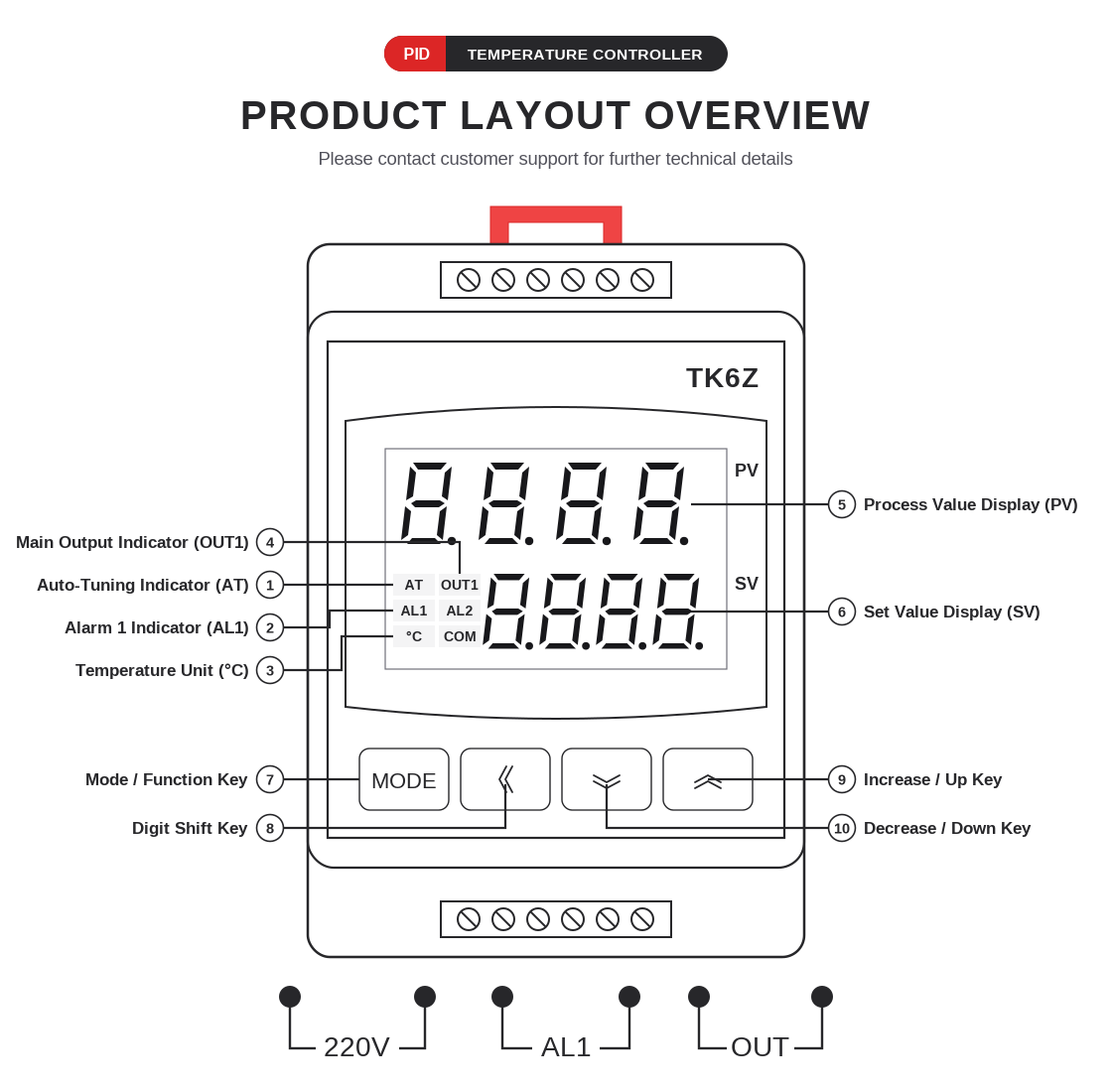
| Display | Two four-digit rows, measured value (PV) above and setpoint (SV) below, with AT, OUT1, AL1, AL2, °C and COM lamps |
| Keys | MODE, a left-shift key, and up and down; MODE opens the parameter menu and confirms a value |
| Control output | Relay and SSR drive together (code RV), relay alone (code R) or SSR drive alone (code V) |
| Relay contact rating | 10A / 800W resistive |
| Alarm output | One alarm output (AL1) on its own two-terminal pair; AL2 and its hysteresis sit in the parameter set but are not brought out on these three versions |
| Communication | RS485 Modbus-RTU on the R and V versions, 8N1, address 1–250, 300–38400 bps (19200 by default); function codes 03 and 06 only |
| Supply voltage | AC100–240V 50/60Hz |
| Dimensions | 45 × 88 × 54mm (W × H × D) |
| Mounting | 35mm DIN rail, clip-on, no panel cut-out |
| Ambient temperature | −10 to 50°C |
| Weight | 0.35kg packed |
| Certification | CE |
| Modbus registers | The same register map as the TK6D: measured value, setpoint, output percentage, autotuning, both alarms and their hysteresis, P, I, D, the integral overshoot limit, the control period, the input offset, the second output's proportional band and cycle time, the dead band and a timer block are all in holding registers; the measured value and the display status are read-only. |
Product overview
Part no. SE-TK6Z
Also known as: TK6Z temperature controller · TK6Z PID controller · TK6Z controlador de temperatura
The TK6Z is the shallow member of the TK6 series: one loop in a rail-mounted module that clips on and needs no cut-out, so the cabinet door stays free for whatever else has to be read through it. The input takes the common thermocouples and both platinum and copper RTDs, chosen in the menu, and the loop runs PID with autotuning — switch it to upper and lower limit control and the same instrument becomes a thermostat with two setpoints instead. Three versions cover the output side: a relay contact, an SSR drive, or both together on the dual-output version, which is the one to take when a contactor and a solid-state relay have to be driven from the same loop. RS485 Modbus-RTU comes with the two single-output versions and exposes the measured value, the setpoint, the tuning constants and both alarms, so the loop can be read from a PLC or a touch panel rather than only watched on its own display. Measured value and setpoint sit on separate rows, which keeps the setpoint visible while the temperature is moving.
Key features
- One loop in a rail-mounted module — no panel cut-out, no meter in the door, and every setting reachable from four keys on the face
- Universal input: Thermocouple K, E, J, R, S, B, T; RTD Pt100 and Cu50
- PID with autotuning, or upper and lower limit control when the job only needs two setpoints
- Relay and SSR drive together (code RV), relay alone (code R) or SSR drive alone (code V)
- One alarm output (AL1) on its own two-terminal pair; AL2 and its hysteresis sit in the parameter set but are not brought out on these three versions
- RS485 Modbus-RTU on the R and V versions, 8N1, address 1–250, 300–38400 bps (19200 by default); function codes 03 and 06 only
- AC100–240V 50/60Hz supply
- Measured value and setpoint on separate four-digit rows, so the setpoint stays visible while the temperature moves
- Screw terminals in two six-way blocks, with the supply, alarm and output groups printed on a label strip beside the lower one
- Samples four times a second, and keeps the loop stable in a cold cabinet
Works with
The parts that go into the same panel and are usually ordered with it.
Panel overview
The front of the TK6Z, drawn square on: both display rows, the lamp column beside the setpoint and the four keys.
Dimensions and rail mounting
The TK6Z case measures 45 × 88 × 54mm (W × H × D) — wider, shorter and far shallower than the TK6D's 23mm-wide, 110mm-tall strip, because the Z trades front-panel real estate for depth behind the rail. Both clip onto the same 35mm DIN rail, so the two can sit side by side on one rail.
| Measurement | Value |
|---|---|
| Width | 45mm |
| Height | 88mm |
| Depth | 54mm |
| Rail | 35mm DIN |
| Panel cut-out | None — rail clip only |
- Dimensions are the published case figures (W × H × D); allow ±0.2mm tolerance when laying out a rail.
- The case clips onto the rail from the front, so allow screwdriver clearance above and below it, not only the 45mm width.
- Depth is measured to the back of the case; a rail-mounted terminal cover, if fitted, adds to the space needed behind the front face.
Supply & OEM
- Stock / sample dispatch
- Typically 3–5 working days for available stock models after stock and order confirmation
- Warranty
- 3 years
- OEM
- Selected models; confirm by quotation
- Shipping
- Worldwide export
Frequently asked questions
Which sensors can the TK6Z read?
Thermocouple K, E, J, R, S, B, T; RTD Pt100 and Cu50
What output options does the TK6Z have?
Relay and SSR drive together (code RV), relay alone (code R) or SSR drive alone (code V)
What supply voltage does the TK6Z need?
AC100–240V 50/60Hz
How accurate is the TK6Z?
±0.5°C, at 0.1°C resolution
Does the TK6Z have alarm outputs?
One alarm output (AL1) on its own two-terminal pair; AL2 and its hysteresis sit in the parameter set but are not brought out on these three versions
What is the temperature range?
0–400°C as standard; 0–1370°C is the widest range the instrument accepts
Related guides
How to Switch TK6D Temperature Controller to SSR Output Mode
This blog explains how to set the TK6D temperature controller to SSR output mode. Includes video demo, step-by-step guide, and highlights of this DIN rail-mounted PID unit.
Read guide Product Updates · 2026-03-24TC5-S PID Temperature Controller: Model Code, Terminals, Outputs and Commissioning
A working reference for the TC5-S 1/16 DIN digital PID temperature controller: how to read the model code, the electrical specification, terminal-by-terminal wiring, how to choose…
Read guide Technical Guides · 2025-04-15How to Wire REX-C100/C400/C700 Temperature Controllers with Relay and SSR Output
This blog provides a comprehensive guide on wiring REX series temperature controllers, including the C100, C400, and C700 models. It explains both relay and solid-state relay…
Read guideRelated models
All Temperature Controllers
TK6D DIN Rail PID Temperature Controller — one loop with heating and cooling outputs
SE-TK6D
116mm from the front face back to the rail, 110mm overall height and 100mm of body between the terminal shrouds
View details
TK6 Series Intelligent Digital PID Temperature Controller with RS485 Communication
SE-TK6
TK6 Series Digital PID Temperature Controller is an intelligent industrial temperature control instrument designed for accurate and stable…
View details
TH4M DIN Rail Four-Channel Temperature Controller — four zones on one module
SE-TH4M
The TH4M puts four measuring channels on one DIN-rail module, so a cabinet full of single-loop meters becomes one strip with four readings stacked on…
View details
REX-C100/C400/C700/C900 Digital PID Temperature Controller
SE-C100
REX Series Digital PID Temperature Controller is a classic and reliable industrial temperature control instrument designed for heating, cooling, and…
View detailsNeed help selecting the right model?
Send us the load, voltage, sensor type and output signal. We reply with the matching model, wiring notes and an OEM quotation.