
Temperature Controllers
XMTG-2001 Digital Temperature Controller with Three-Digit Thumbwheel Setting
XMTG-2001 digital temperature controller: 48×48mm front, 45×45mm cut-out, 0–399°C range, ±1%FS accuracy, 3A at 220VAC relay.

- Panel size
- 48×48mm (1/16 DIN)
- Panel Cutout
- 45×45mm
- Output Type
- Relay contact, NO / NC
- Power Supply
- 220VAC 50/60Hz
Order codes of this series
This series is built in more than one version. Each has its own page with the complete order code, the output stage it carries and what that stage can switch; the case, the cut-out and the supply stay the same.
| Order code | Output stage | Bezel (mm) | Cut-out | Open |
|---|---|---|---|---|
| XMTG-2001 K 399 | Relay output | 48 x 48 x 81 | 45 x 45 mm | XMTG-2001 K 399 → |
| XMTG-2001 K 999 | Relay output | 48 x 48 x 81 | 45 x 45 mm | XMTG-2001 K 999 → |
Technical specifications
| Product Name | Digital Temperature Controller |
|---|---|
| Series | XMTG Series |
| Model versions | XMTG-2001 K / E thermocouple, XMTG-2002 Pt100 / Cu50 RTD |
| Display Type | 3-digit red LED display |
| Setting method | Three-digit thumbwheel (hundreds, tens, units), °C scale |
| Control mode | ON/OFF (position control) |
| Sensor Inputs | K / E thermocouple, or Pt100 / Cu50 RTD on XMTG-2002 |
| Temperature range | 0–399°C on K, E, Pt100 and Cu50 versions; 0–999°C on the K-type 999 version |
| Resolution | 1°C; 0.1°C on XMTG-2002 RTD versions |
| Accuracy | ±1%FS |
| Output Type | Relay contact, NO / NC |
| Contact rating | 3A at 220VAC |
| Load (resistive) | 500W direct; larger loads through a contactor |
| Response time | 1s |
| Power Supply | 220VAC 50/60Hz |
| Power consumption | Under 3VA |
| Cold junction compensation | Error under 2°C between 0 and 40°C |
| Setpoint memory | Held mechanically by the thumbwheel; no battery |
| Mounting | Snap-in clip, panel mount |
| Housing | ABS, self-extinguishing |
| Panel size | 48×48mm (1/16 DIN) |
| Panel Cutout | 45×45mm |
| Depth behind panel | 80mm |
| Ambient | 0 to 50°C, 85% RH max, non-corrosive |
| Certification | CE |
| Application | Injection molding, packaging machinery, ovens, incubators, food equipment |
| Direct heater load | 500 W maximum in the direct arrangement, with the jumper between terminals 2 and 5 fitted |
Product overview
Part no. SE-XMTG-2001
Also known as: XMTG-2001 · 48×48mm Thumbwheel Temperature Controller · On/Off Panel Thermostat
The XMTG-2001 is a square panel controller whose setpoint is set on a three-digit thumbwheel instead of through a parameter menu. The numbers are visible on the front, they stay where they are put, and they are hard to change by accident when someone brushes the panel. A three-digit LED display above the thumbwheel shows the measured temperature, and a relay contact switches the heater. It is the instrument for machines where the operator is a machine setter rather than an instrument technician: extruders, sealing and packaging lines, small ovens and incubators.
Key features
- Setpoint on a three-digit thumbwheel, visible on the front and hard to change by accident
- 1°C LED readout of the measured temperature
- 0–399°C range on K, E, Pt100 and Cu50 inputs
- ON/OFF control with a relay contact — no parameter menu to walk through
- Relay contact rated 3A at 220VAC; up to 500W direct, a contactor above that
- 48×48mm front, 45×45mm cut-out, 80mm behind the panel
- Setpoint held mechanically, so it survives a power cut without a battery
- Cold junction compensation built in on the thermocouple versions
- Screw terminals in two columns, with the assignment printed on the side of the case
- ABS housing, CE marked
Works with
The parts that go into the same panel and are usually ordered with it.
AC contactor
SE-CJX2
The 250 VAC / 3 A relay drives the coil; a contactor switches heaters above 750 W
K / E probe
SE-KPROBE
Factory-fixed K or E input, matched to the calibrated range of the ordered version
Pt100 / Cu50 RTD
SE-TC-WRNK236
Sheathed Pt100 or Cu50 probe for the fixed-range RTD versions, max 999 °C
Compatible sensors & outputs
also supplied as 48×48 mm thumbwheel on/off temperature controller, mechanical dial panel thermostat
| Sensor | Range | Available as |
|---|---|---|
| K | Factory-fixed range, max 999 °C | K / E probe thermocoupleStainless steel probeSpring-loaded M12 probeRing-terminal thermocoupleThreaded shielded-lead probe |
| E | Factory-fixed range, max 999 °C | K / E probe thermocoupleStainless steel probeM6 / M8 screw-in probe |
| Pt100 | Factory-fixed range, max 999 °C | Pt100 / Cu50 sheathed RTDM6 / M8 screw-in probe |
| Cu50 | Factory-fixed range, max 999 °C | Pt100 / Cu50 sheathed RTD |
Output types and what goes with them
| Output | Rating | Order with it |
|---|---|---|
| Dry-contact relay | 250 VAC / 3 A (resistive load ≤ 750 W); drives an external contactor for larger heaters | CJX2 AC contactor |
Terminal connections and wiring
Twelve terminals in two columns: 1 to 6 down the left, 7 to 12 down the right. The supply lands on 1 and 2, the relay contact is 4 (NO) and 6 (NC) around a common on 5, and the sensor on 11 and 12. A factory link joins 2 to 5, and that link is what puts the neutral on the common of the contact — without it the output switches nothing. The direct-heater arrangement is rated 500 W. Above that, switch through a contactor. Both arrangements require the jumper between terminals 2 and 5.
Heater on the output contact
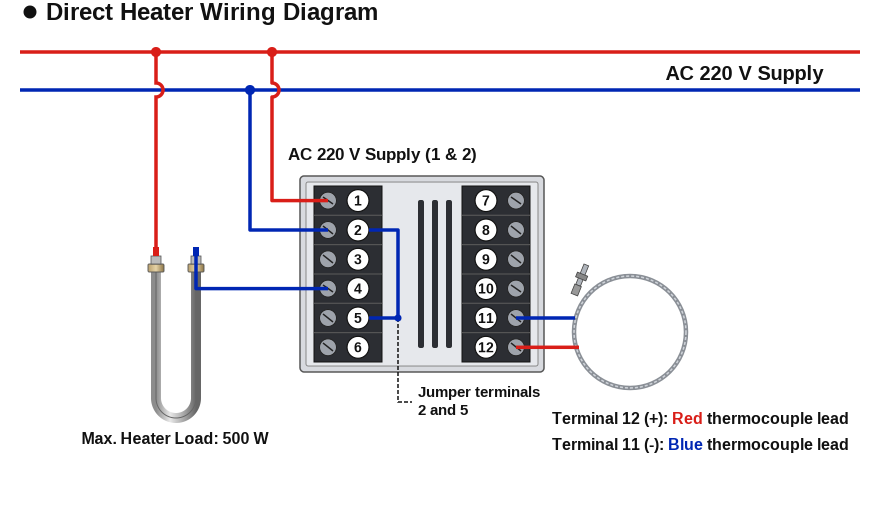
The element hangs between the live on 1 and the contact on 4. When the controller calls for heat the contact closes, 4 joins the common on 5, and the 2–5 link ties that common to the neutral — so 4 becomes the neutral side of the element and the circuit completes through it. The limit for direct switching is 500W, which is 2.3A: above that the contact carries more than it is rated for and the load goes through a contactor instead.
Contactor between the output and the load
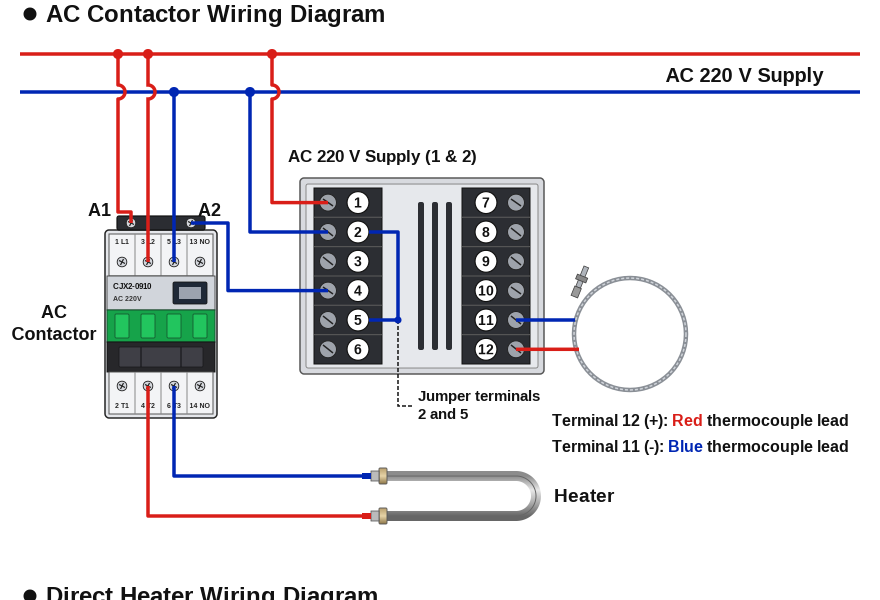
4 now feeds A2 and A1 takes the live from 1, so the coil sees live on one end and switched neutral on the other, and the controller only ever carries the coil current. The element is switched by two poles: L2 takes the live and L3 the neutral, and T2 and T3 carry them down to the heater. L1, T1 and the auxiliary 13NO / 14NO stay unused on a single-phase load.
Wiring notes
- The supply is 220VAC on 1 (live) and 2 (neutral). The 2–5 link is fitted at the factory and has to stay: 5 is the common of the relay, 4 the normally-open contact and 6 the normally-closed one, so the contact switches the neutral, not the live. Put the element between 1 and 4 — across 4 and the neutral it would never heat.
- 12 takes the red thermocouple lead and 11 the blue one, as the diagram printed on the side of the case has it. Reversed, the reading falls as the machine heats up — the usual first fault on a new version.
- The contact is rated 3A at 220VAC, and a directly switched heater is capped at 500W — 2.3A, which leaves room for the cold-resistance inrush. Above that, use a contactor rather than a larger fuse.
- Terminals 3, 7, 8, 9 and 10 are not used on this version. They are brought out on the block because other versions in the series use them — read the label on the unit before treating them as spare.
Setting the temperature without a menu
Three wheels — hundreds, tens and units — set the temperature, and the red LED row above them shows what the sensor is actually reading. That is the whole interface. There is no parameter list to enter, no lock code and no hold-to-scroll, so a machine setter changes the number and walks away without being taught the instrument.
Because the setpoint is a mechanical wheel it cannot be lost. Controllers that keep the setpoint in memory need a battery or an EEPROM and come back to a default after a long shutdown; a thumbwheel is wherever it was left. The trade is resolution — one degree per wheel — so this is not the instrument for a process that needs a tenth of a degree.
- XMTG-2001 — K or E thermocouple input, 0–399°C, plus a 999°C version of the K version
- XMTG-2002 — Pt100 or Cu50 RTD input, 0–399°C, with a tenth-of-a-degree display
- 48 × 48 mm front in a 45 × 45 mm cut-out, 80 mm behind the panel
- Relay contact brought out on both NO and NC, so the same unit can switch a heater on or an alarm off
- ON/OFF control only: there is no PID loop and no auto-tune on this version
- Two columns of screw terminals numbered 1 to 12, with the assignment printed on the side of the case
Which version to order
The five variants differ in the sensor they read, not in the case: every one of them is the same 48 mm square instrument and the same cut-out. Pick the sensor first, because that also settles the temperature range and the resolution, and only then the range you need on top of it.
K type covers the widest window and is what most extruder and sealing-press barrels use. E type resolves small changes better at the low end and is worth taking where the process sits under about 200°C. Pt100 and Cu50 versions read a resistance element instead of a thermocouple, which is the right choice when the sensor has to be stable over years or when the machine already has an RTD in it — and those versions are the only ones that show a tenth of a degree.
- XMTG-2001, K type, 0–399°C — the general-purpose version
- XMTG-2001, K type, 0–999°C — for high-temperature work; the display is still three digits
- XMTG-2001, E type, 0–399°C — the low-end version with the finest thermocouple resolution
- XMTG-2002, Pt100, 0–399°C — RTD input, tenth-of-a-degree display
- XMTG-2002, Cu50, 0–399°C — the cheapest of the five, for low-temperature work
Supply & OEM
- Stock / sample dispatch
- Typically 3–5 working days for available stock models after stock and order confirmation
- Warranty
- 3 years
- OEM
- Selected models; confirm by quotation
- Shipping
- Worldwide export
Related guides
TEL96-9001 or TEL96-2001: Choosing the Right Oven Temperature Controller
The TEL96 series is a 96 x 96 mm on/off oven temperature controller built around a K-type thermocouple input and a 10 A relay contact. It is made in two versions, the TEL96-9001…
Read guide Product Updates · 2025-04-11TCN4 Series PID Temperature Controller: Model Codes, Inputs, Outputs and Commissioning
A working reference for engineers specifying or commissioning a TCN4 series digital PID temperature controller: how the four panel sizes differ, which sensor inputs are accepted,…
Read guide Product Updates · 2026-03-24TC5-S PID Temperature Controller: Model Code, Terminals, Outputs and Commissioning
A working reference for the TC5-S 1/16 DIN digital PID temperature controller: how to read the model code, the electrical specification, terminal-by-terminal wiring, how to choose…
Read guideRelated models
All Temperature Controllers
XMTG-MS Digital Temperature Controller
SE-XMTG-MS
The version that takes any supply from 24 to 240 VAC without a voltage variant: K, E, J, Pt100 or Cu50 on the input, a 5 A relay plus a 12 V SSR…
View details
XMTD Series Digital Temperature Controller
SE-XMTD
The XMTD-2001 and XMTD-2201 are 72×72 mm panel-mount On/Off temperature controllers built for straightforward, menu-free operation. Operators set the…
View details
XMTA-MS Digital Temperature Controller
SE-XMTA-MS
Same face and the same terminal count as the XMTE version, in a square panel format: a 5 A relay output on 12-14, a 12 V DC 20 mA SSR drive on 10-11,…
View details
XMTD-MS Digital Temperature Controller
SE-XMTD-MS
Same face as its brothers - four digits, the three limit legends, MODE and two arrows - but wired differently: a 20 mA SSR drive on 10 and 11, and…
View detailsNeed help selecting the right model?
Send us the load, voltage, sensor type and output signal. We reply with the matching model, wiring notes and an OEM quotation.